Below is the code for an example image modal link
Flashcards
/* -- Un-comment the code below to show all parts of question -- */
Which of the following is the primary objective of probability proportional to sample size?

Overstating assets or understating liabilities is generally done to improve an entity's financial position. Overstatements tend to be performed in large amounts and understatements in smaller amounts. For example, overstating a $2,000 asset transaction may be recorded as $20,000, whereas an understated liability for the same amount could be recorded as $20.
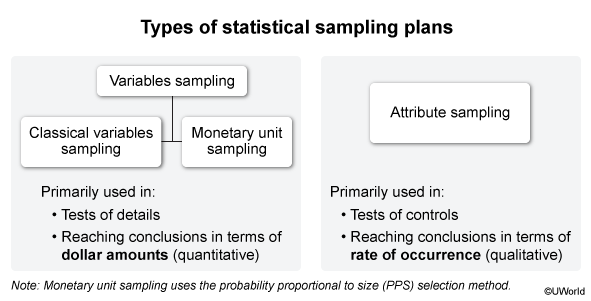
Probability proportional to size (PPS) is a sample selection method in which items are chosen based on their dollar value; therefore, larger (not smaller) values have a greater chance of selection (Choice B). An advantage of this method is that it helps to identify overstatement errors.
(Choice C) PPS sampling is a variables sampling method used to reach conclusions about reasonableness of dollar amounts. In contrast, control testing is normally performed using attribute sampling, which is used to reach conclusions about the rate of occurrence for a specific qualitative characteristic (eg, properly signing checks).
(Choice D) Classical variables sampling treats individual items as a sampling unit, regardless of dollar amount. Because dollar amount is not factored into the method, it can be easily applied to identify zero and negative balances, which is useful to test for understatements.
Things to remember: Probability proportional to size (PPS) is a sample selection method in which items are chosen based on their dollar value. Because larger values have a greater chance of selection, PPS is used to test for overstatements. In contrast, classical variables sampling treats individual items as a sampling unit, regardless of dollar amount, which is useful to test for understatements.