








CMA® Review Courses by UWorld
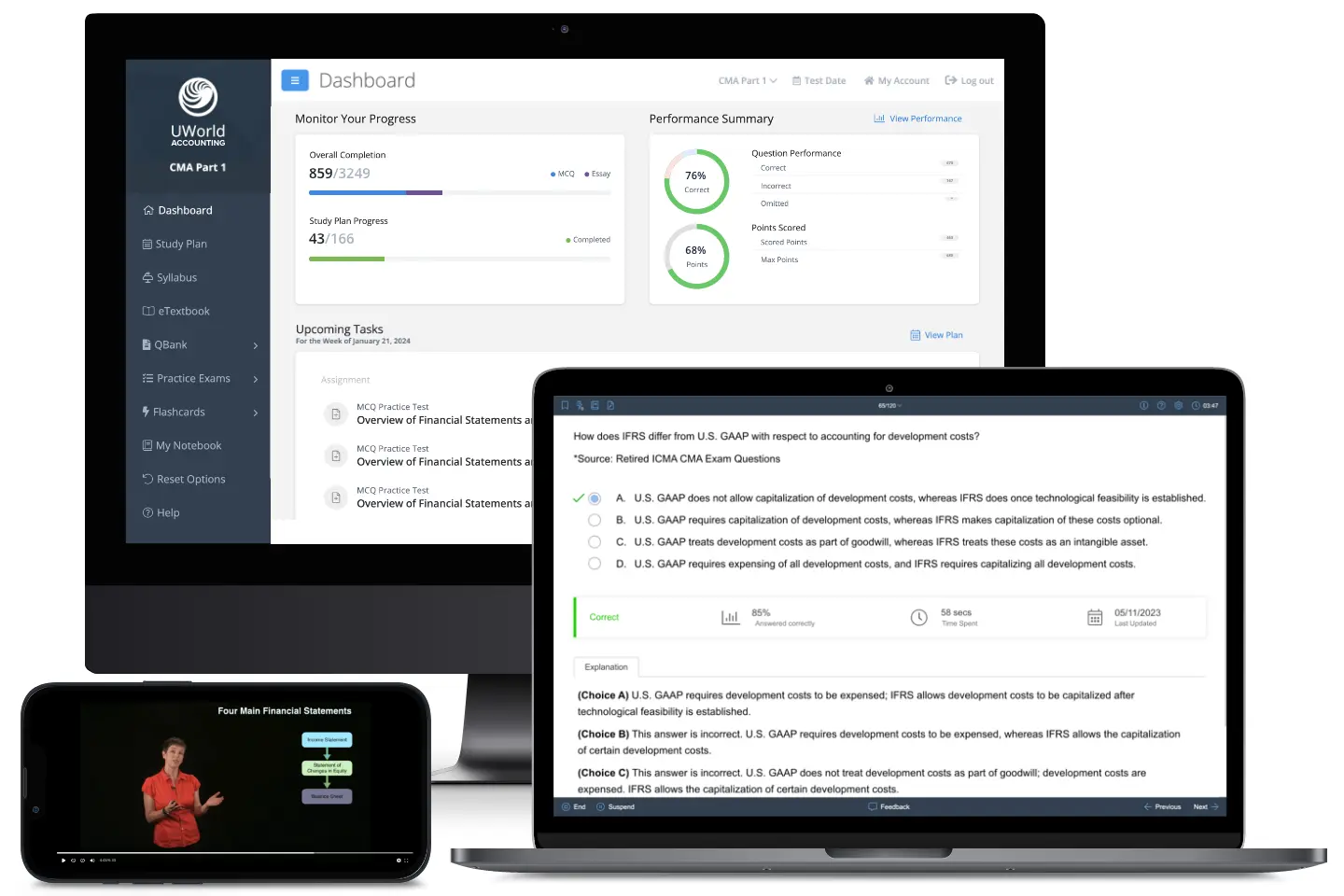
Know exactly when you're ready to pass. UWorld Certified Management Accountant (CMA®) Review Courses combine CMA exam-like questions with detailed explanations, engaging video lectures, SmartPath Predictive Technology®, UAsk AI™, and study guides that help you master concepts faster and prepare confidently for the 2026-2027 CMA exam. As one of the most trusted CMA exam review courses available, UWorld is a proud strategic partner of the Institute of Management Accountants (IMA®).
Choose Your CMA® Course Package
Whether you’re searching for a course with live instruction and unlimited access or just the basics, we have you covered for the 2026-2027 CMA exam.
Print + eBook
eBook Only
Choose Your CMA® Course Package
Whether you’re searching for a course with live instruction and unlimited access or just the basics, we have you covered for the 2026-2027 CMA exam.
Study the most current material with a full course mapped to the Institute of Certified Management Accountants’ (ICMA) Learning Outcome Statements (LOSs) for Parts 1 and 2.
Enhance your understanding of difficult CMA exam topics with 150 engaging video lectures.
|
Print + eBook |
Build your test-taking and time-management skills with unlimited practice exams and 2 full-length mock exams with a unique set of curated questions.
Enter your exam date and desired study hours, and we’ll generate your personalized study plan. Choose from a set plan, flexible plan, or customized plan.
SmartPath® provides data-supported targets based on the performance of successful CMA candidates. Targets help you easily gauge your preparedness for exam day.
UAsk is an AI-powered study assistant designed to help you stay focused and increase your grasp of the material. It delivers accurate, context-relevant answers exactly when and where you need them.
Track your study progress with personalized data on your completed lessons, test bank, mock exam performance, and more.
Create your own customizable digital flashcards or study our expert ReadyDecks with 1,200+ pre-loaded flashcards.
Study on the go with mobile app access to all your CMA course materials. Watch videos online or offline. The app is available on Android and Apple.
As an IMA strategic partner, we’re pleased to offer you an exclusive 30% discount on your one-time CMA program enrollment fee and IMA membership. An IMA redemption code will be sent via email after submitting your order.
Join our virtual boot camp series with live, online instruction and support. All sessions are also archived for viewing on demand.
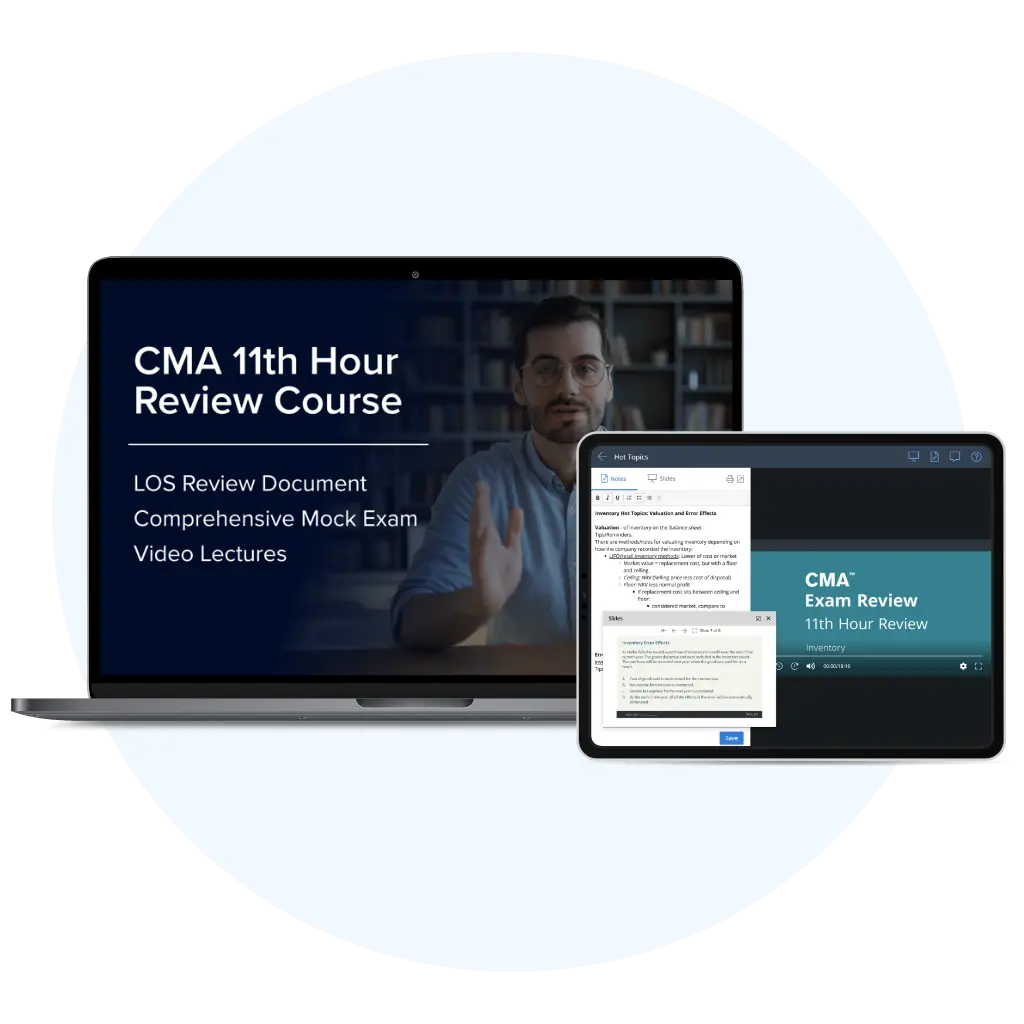
Maximize your final weeks of CMA exam prep with an additional 40+ video lectures covering the most critical topics and 2 additional mock exams with questions not seen before.
Access your course until you pass and receive free online updates with our StudyPass program.
Study the most current material with a full course mapped to the Institute of Certified Management Accountants’ (ICMA) Learning Outcome Statements (LOSs) for Parts 1 and 2.
Enhance your understanding of difficult CMA exam topics with 150 engaging video lectures.
|
eBook Only |
Build your test-taking and time-management skills with unlimited practice exams and 2 full-length mock exams with a unique set of curated questions.
Enter your exam date and desired study hours, and we’ll generate your personalized study plan. Choose from a set plan, flexible plan, or customized plan.
SmartPath® provides data-supported targets based on the performance of successful CMA candidates. Targets help you easily gauge your preparedness for exam day.
UAsk is an AI-powered study assistant designed to help you stay focused and increase your grasp of the material. It delivers accurate, context-relevant answers exactly when and where you need them.
Track your study progress with personalized data on your completed lessons, test bank, mock exam performance, and more.
Create your own customizable digital flashcards or study our expert ReadyDecks with 1,200+ pre-loaded flashcards
Study on the go with mobile app access to all your CMA course materials. Watch videos online or offline. The app is available on Android and Apple.
As an IMA strategic partner, we’re pleased to offer you an exclusive 30% discount on your one-time CMA program enrollment fee and IMA membership. An IMA redemption code will be sent via email after submitting your order.
Looking for a Single Part Review?
Discover the UWorld Difference
Videos by Expert CMA Instructors
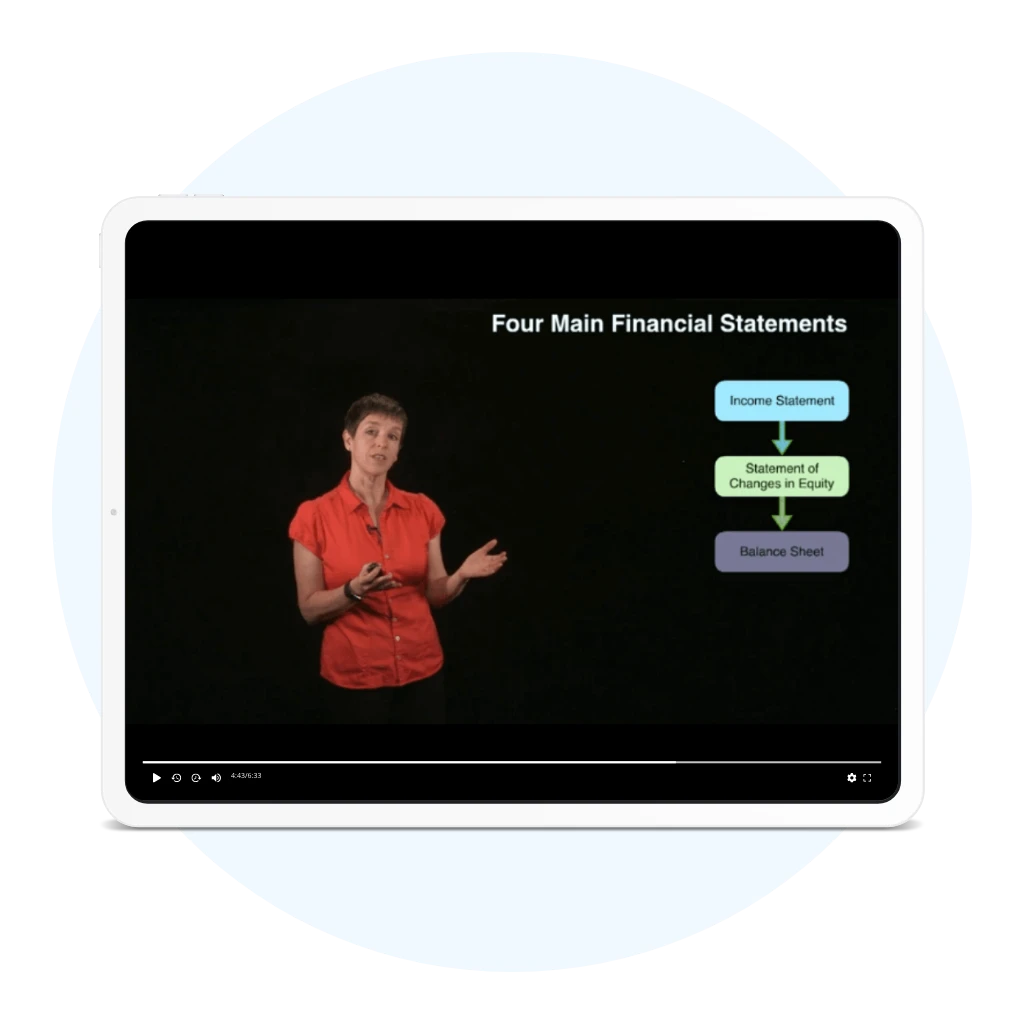
UWorld’s video lectures, led by expert CMA instructors, authors, and subject matter experts, break down complex management accounting concepts into clear, engaging lessons. Using real-world examples and proven mnemonics, they make tough topics intuitive. Each instructor brings unique CMA exam expertise and industry knowledge to every video.
Study Guides: 100% Aligned to the CMA Exam
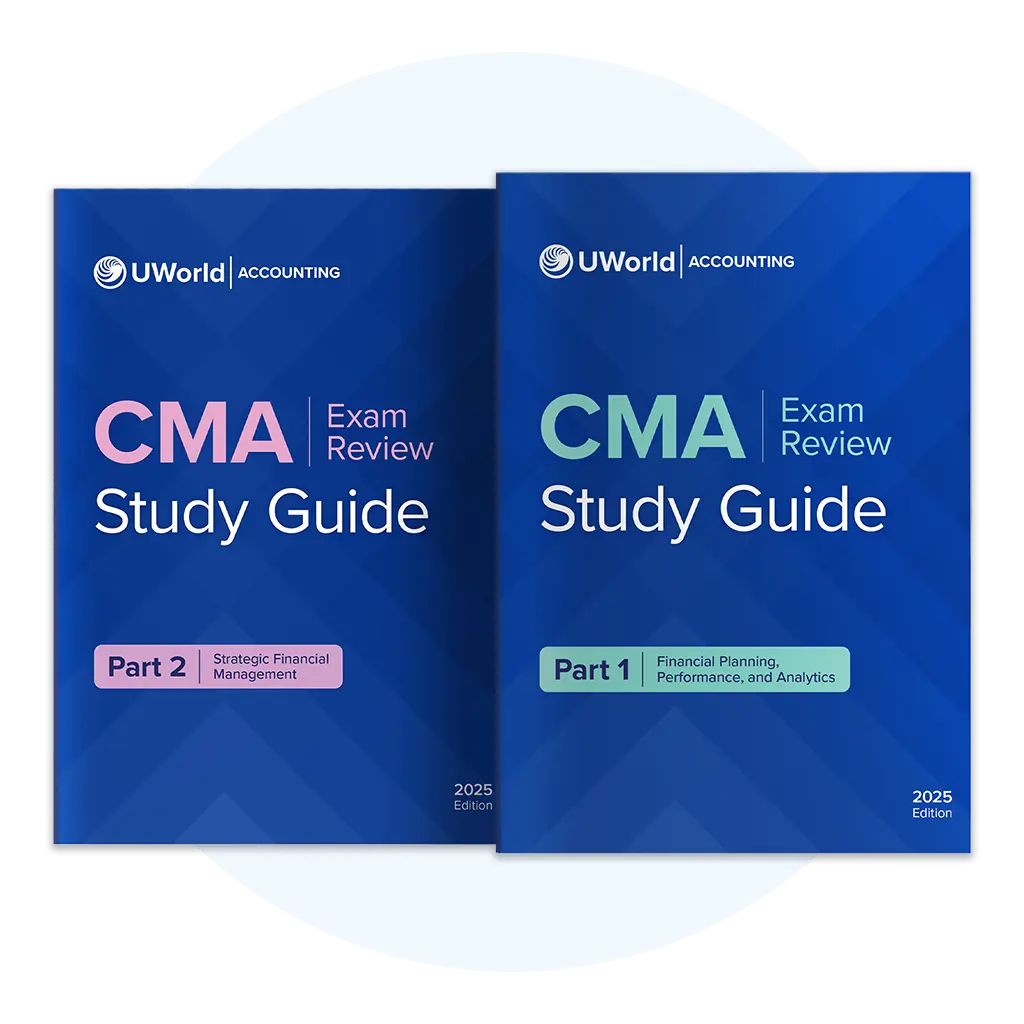
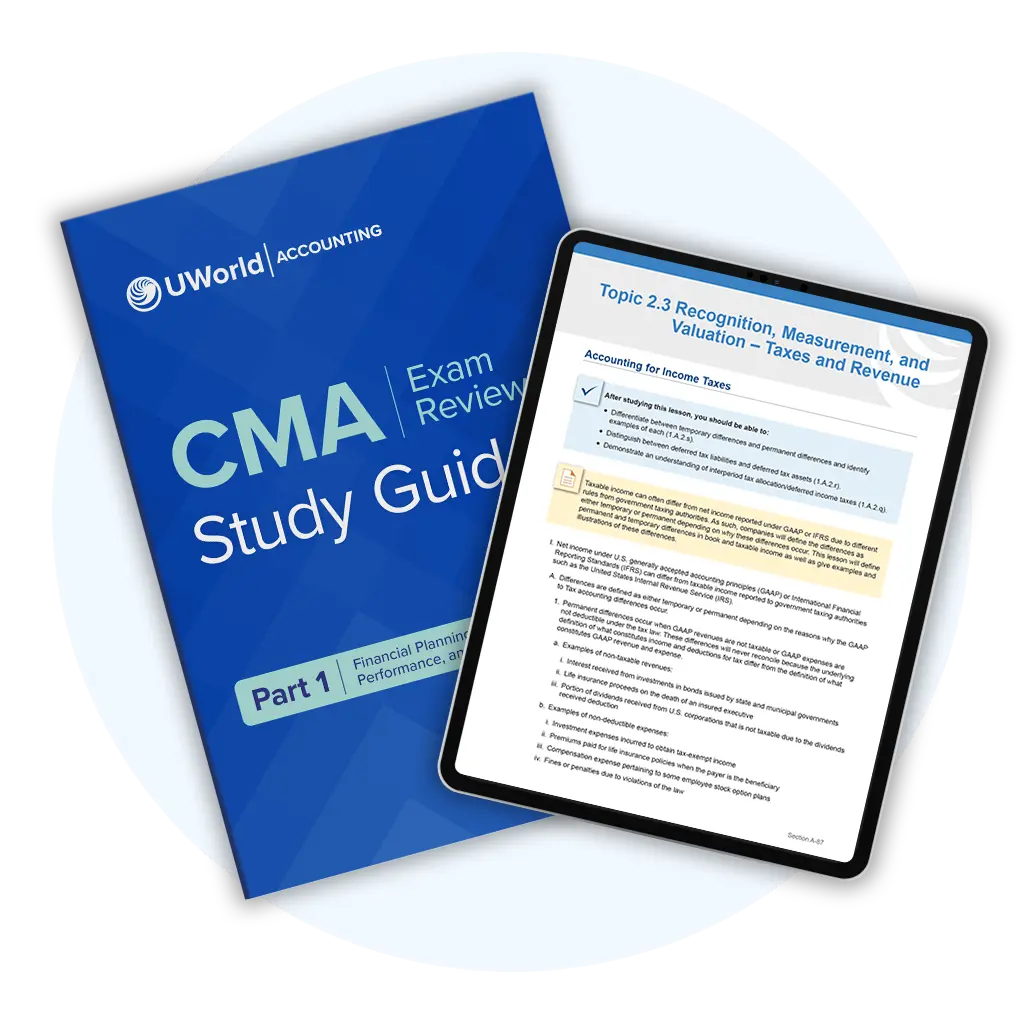
UWorld CMA textbooks follow ICMA’s Content Specification Outlines (CSOs) and Learning Outcome Statements (LOSs), covering all of the tested material. These visually engaging study guides use real-world examples, tables, charts, and diagrams to reinforce concepts, supporting full understanding, not just memorization.
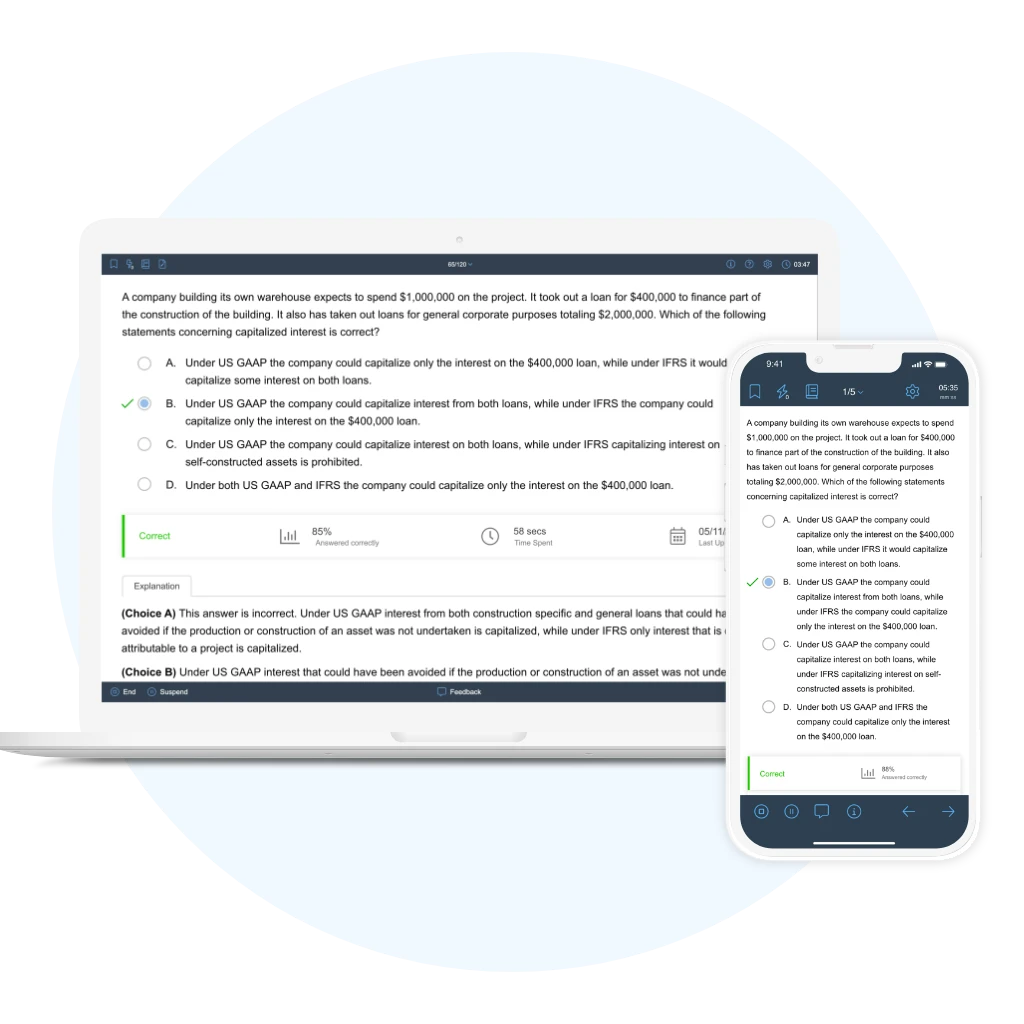
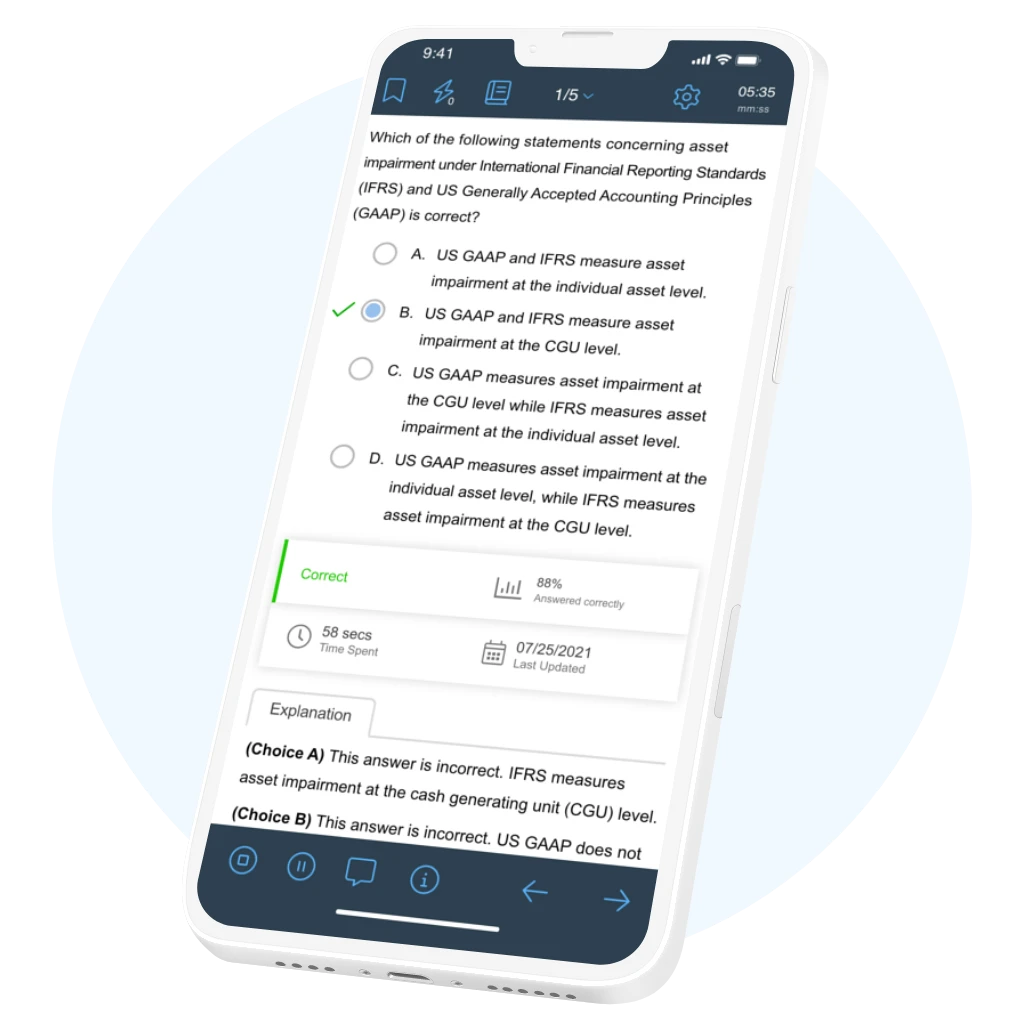
6,200+ Exam-Like Questions with Visuals
The CMA Part 1 exam includes 100 multiple-choice questions and two case-based questions. See if you can answer these free questions now.
Question
At the end of Year 3, the managers of Guardian Company are planning for Year 4. In Year 3, manufacturing overhead was $349,600, direct labor hours equaled 16,000 hours, and machine hours totaled 48,000 hours. For Year 4, manufacturing overhead is estimated to be $524,400, direct labor hours are estimated at 20,000 hours, and machine hours are estimated at 50,000 hours. If overhead is applied based on direct labor hours, what is the predetermined overhead rate for Year 4 (if necessary, round your answer to two decimal places)?
| A. $10.49 per direct labor hour. | |
| B. $32.78 per direct labor hour. | |
| C. $21.85 per direct labor hour. | |
| D. $26.22 per direct labor hour. |
Explanation
(Choice A) Incorrect. This amount is Year 4 estimated overhead divided by Year 4 estimated machine hours. Because overhead is applied based on direct labor hours, do not divide by machine hours to calculate the predetermined overhead rate.
(Choice B) Incorrect. This amount is Year 4 estimated overhead divided by Year 3 direct labor hours. When calculating the Year 4 predetermined overhead rate, use estimates from Year 4.
(Choice C) Incorrect. This amount is Year 3 estimated overhead divided by Year 3 direct labor hours. When calculating the Year 4 predetermined overhead rate, use estimates from Year 4.
(Choice D) Correct. The predetermined overhead rate based on direct labor hours for Year 4 equals the estimated overhead for Year 4 divided by the estimated direct labor hours for Year 4. The predetermined overhead rate equals $26.22 per direct labor hour ($524,400 ÷ 20,000 direct labor hours).
Question
Which of the following emerging technologies can help in improving the efficiency of manufacturing plant assembly operations and warehouse operations?
| A. 3D printing | |
| B. Robots | |
| C. Virtual reality | |
| D. Internet of Things |
Explanation
(Choice A) Incorrect. 3D printing technology is useful in improving the efficiency and accuracy of product design whether it is a manufacturing product (e.g., an automobile or a vacuum cleaner), clothes, or shoes.
(Choice B) Correct. Robotic technology or robotic process automation (RPA) improves the speed and accuracy of assembling various parts or components in a manufacturing plant, soldering and painting subassemblies and final assemblies of parts, and other labor-intensive tasks. Similarly, robots operate in a warehouse and distribution center to locate the desired product on a warehouse shelf, to place the product in a shipping container, and to get ready for shipping to a customer so the customer order is fulfilled. The overall benefits of RPA include reduced labor costs due to less time to complete tasks, increased speed and accuracy, improved worker productivity (i.e., doing more tasks in less time), reduced human errors from not shipping wrong products to customers, and increased customer satisfaction with faster and more accurate order fulfillment process.
(Choice C) Incorrect. Virtual reality (VR) technology is a leading-edge technology applied to retail business that replicates or simulates the real world through images (goggles) and sounds that can be heard from speakers and headphones (headsets). It creates 3D graphic models to interact with images. A user of the VR equipment is immersed in a real lifelike experience while interacting with computer-simulated environment. VR technology started in video games, pilot training, and motion pictures. The VR technology has entered into medical training, military training, and other kinds of training. The goal of retailers with VR technology is to turn viewers (shoppers) into buyers (customers).
(Choice D) Incorrect. The Internet of Things (IoT) technology is a collection of several diverse and disparate technologies aimed at providing efficiency gains to a business and convenience and comfort to consumers’ day-to-day life at home. Within a business environment, the IoT means connecting or networking several systems and devices and passing data between them to operate as one seamless and cohesive system, providing insights, and requiring management decisions and actions.
Question
All of the following statements concerning currently attainable standards are correct except:
| A. Currently attainable standards assume machines will be taken off-line for preventative maintenance. | |
| B. Currently attainable standards assume employees work at a normal pace. | |
| C. Currently attainable standards can only be reached by the most skilled and efficient employees. | |
| D. Currently attainable standards are expected to be achieved most of the time. |
Explanation
(Choice A) Incorrect. Currently attainable standards are sometimes called reasonably attainable standards as they can be achieved under normal operating conditions. One example of normal operating conditions is that machines need to be taken off-line for preventative maintenance from time to time to keep them operating properly.
(Choice B) Incorrect. Currently attainable standards are sometimes called reasonably attainable standards as they can be achieved under normal operating conditions. One example of normal operating conditions is that employees work at a normal pace by taking breaks from time to time.
(Choice C) Correct. An organization can use ideal standards or currently attainable standards to develop budgets. Ideal standards can only be reached by the most skilled and efficient employees while currently attainable standards require average workers who are properly trained.
(Choice D) Incorrect. Currently attainable standards are sometimes called reasonably attainable standards as they can be achieved under normal operating conditions. Because they can be achieved under normal operating conditions, they should be achieved most of the time.
Question
Fashionable Purses (FP) is about to begin its annual budgeting process, but would like to make the process more informative. Specifically, FP is facing product demand uncertainty. Management is forecasting that FP will sell around 30,000 purses; however, this amount could be 20% more or 30% less. What tool or method should FP employ this year to make the budget process more informative?
| A. A zero-based budget | |
| B. A flexible budget | |
| C. An activity-based budget | |
| D. A continuous rolling budget |
Explanation
(Choice A) Zero-based budgeting demands that all budgeting choices are taken back to a “blank page” to be fully evaluated and, if approved, put into the master budget plan. While this process could be informative to FP management, they will not receive the “what if” information they are seeking in this situation.
(Choice B) Flexible budgets are used to examine possible future (“what if”) scenarios in sales volume. A flexible budget would provide the information that FP management is seeking in this situation.
(Choice C) Activity-based budgeting focuses on identifying and using core activities throughout the organization to establish activity cost rates to assign costs to products, customers, and other business targets based on actual consumption relationships. While this process will be informative to management, it will not provide the (“what if”) information they are seeking in this situation.
(Choice D) Rolling budgets are particularly helpful to organizations that want to avoid an annual master budget planning event that can consume a large block of management time. While it's true that FP management does plan the budget annually; in this situation, they are not worried about saving time. They are worried about making the budgeting process more informative.
Question
Which of the following statements is correct concerning a company using budgeted output to calculate an allocation rate?
| A. The company will be more likely to be able to evaluate the cost of unused capacity than if it used practical capacity to calculate its allocation rate. | |
| B. The company will be less likely to experience a product pricing death spiral than if it used theoretical capacity to calculate its allocation rate. | |
| C. The company will be more likely to have to adjust its allocation rates than if it used practical capacity to calculate its allocation rate. | |
| D. The company will allocate less cost to its products than if it used theoretical capacity to calculate its allocation rate. |
Explanation
(Choice A) This answer is incorrect. Unused capacity can be broken down into unplanned unused capacity and planned unused capacity. Unplanned unused capacity refers to the difference between actual output and budgeted output while planned unused capacity refers to the difference between budgeted output and the denominator used in the allocation rate. By using budgeted output, the company can only calculate the cost of unplanned unused capacity. If it uses practical capacity, it can calculate the cost of planned unused capacity and unplanned unused capacity.
(Choice B) This answer is incorrect. A product pricing death spiral is more likely to occur if budgeted output is used to calculate an allocation rate, since the allocation rate will increase as budgeted output decreases. The higher rate results in a higher selling price, further decreasing budgeted output, which accelerates the spiral. Since theoretical capacity is not likely to change, the allocation rate based on it is also unlikely to change.
(Choice C) This answer is correct. When calculating allocation rates, companies have discretion on what level of output to use for the denominator of the calculation. The choices are practical capacity (output under realistic circumstances), theoretical capacity (output under ideal circumstances), and budgeted output (output expected in the period). One result of using budgeted output is that it increases the likelihood that allocation rates will change from one period to the next. Budgeted output represents expected output for a given period, while practical capacity represents capacity under realistic circumstances. Expected output is more likely to change from one period to the next than is what is “realistic” output. As a result, an allocation rate based on expected output is more likely to change from one period to the next than is a rate based on “realistic” output.
(Choice D) This answer is incorrect. The higher the allocation rate, the more overhead will be allocated to actual output. Since budgeted output can never be higher than theoretical capacity, an allocation rate based on budgeted output can never be lower than an allocation rate based on theoretical capacity.
Question
Take a look at a typical sample question from another provider below. The question shows you what you’ll see on the exam, but that’s not enough to help you pass. Their explanation addresses the correct answer choice but does not go the extra mile to explain the incorrect choices so that you don’t make the same mistakes on exam day.
Nemo Diving Products, Inc. usually stores its product inventory in a special area within its manufacturing facility. Due to a recent fire, all inventory this month was stored offsite at a cost of $3,000. Some inventory items are normally purchased from Switzerland. This month’s import duty was $2,000. This month’s unreimbursable freight charges on products sold were $4,000. Given the above three costs, what amount(s) are chargeable to inventory vs. chargeable to expense?
|
Inventory
|
Expense
|
||
|
A.
|
$2,000
|
$7,000
|
|
|
B.
|
$9,000
|
$0
|
|
|
C.
|
$5,000
|
$4,000
|
|
|
D.
|
$3,000
|
$6,000
|
Explanation
“A” is correct.
Import duty should be charged to inventory. The other two items are expensed as incurred. The $3,000 warehousing cost is not chargeable to inventory since it is not a “usual” cost. To be included in inventory, a cost must be usual, necessary and make the item ready for sale. The $4,000 freight charge is a selling expense.
“B” “C,” and “D” are incorrect per the above explanation.
The CMA Part 2 exam also includes 100 multiple-choice questions and two case-based questions. See if you can answer these free questions now.
Question
The management team at an organization has recently begun to bond certain employees to prevent cash embezzling and other unethical activity. Is this an appropriate step?
| A. No, bonding employees has not been proven to prevent unethical activities linked to cash activities, back reconciliation, or depositing cash receipts. | |
| B. Yes, bonding employees helps protect the organization from potentially unethical activity, including but not limited to embezzling cash, misreporting cash amounts, or other fraudulent actions. | |
| C. Yes, instituting an employee bonding program protects employees from top-down pressure initiated by management to boost financial performance. | |
| D. No, employee bonding is only linked to the technology processes underlying financial reporting, so it would not have any benefit for the firm. |
Explanation
(Choice A) Incorrect. Bonding employees, especially at larger organizations that have standalone treasury and/or accounts receivable functions, is a logical step to help offset the risk of unethical activity.
(Choice B) Correct. Bonding employees is a logical step that protects the organization from potentially unethical activities by employees, especially concerning cash-related activities. It does not stop the employees from committing such actions, but provides funds to mitigate the impact.
(Choice C) Incorrect. Employee bonding protects the organization from unethical actions of employees, and not employees from top-down pressure from management.
(Choice D) Incorrect. Bonding employees is directly linked to cash-related activities, and protecting the firm from unethical activities connected to cash-linked actions.
Question
Which of the following is an example of the loss event data technique of identifying events within an Enterprise Risk Management (ERM) approach to risk management?
| A. The head of HR holds a meeting with employees to get their ideas on possible steps to improve the hiring process. | |
| B. A company maps out the process for conducting position searches and hiring new employees. | |
| C. A company considering outsourcing its payroll function consults a list of events related to outsourcing payroll developed by a consulting firm. | |
| D. A delivery company analyzes losses from accidents its vehicles were in to see if any patterns emerge.. |
Explanation
(Choice A) This is an example of the facilitated workshop and interviews technique since this technique involves drawing on the accumulated experience of all involved parties through structured discussions and interviews. Therefore, this is an incorrect answer.
(Choice B) A company mapping out the process for conducting position searches and hiring new employees is practicing the process flow analysis technique since this technique involves assessing the steps an organization goes through in order to identify events of interest. Therefore, this is an incorrect answer.
(Choice C) This company is practicing the event inventories technique since this technique involves using lists of generic events related to a particular project as a starting point for event identification. Therefore, this is an incorrect answer.
(Choice D) This is an example of the loss event data technique since this technique involves analyzing past data on loss events to assess trends. Therefore, this is the correct answer.
Question
Which of the following statements about contribution margin is true?
| A. A decrease in variable administrative expenses per unit will decrease contribution margin per unit. | |
| B. A decrease in fixed administrative expenses per unit will not impact contribution margin per unit. | |
| C. An increase in variable administrative expenses per unit will increase contribution margin per unit. | |
| D. A decrease in variable administrative expenses per unit will not impact contribution margin per unit. |
Explanation
(Choice A) Incorrect. This statement is not true. A decrease in variable administrative expenses per unit will increase, not decrease, contribution margin per unit as a smaller variable cost per unit will be subtracted from the sales price when calculating contribution margin per unit.
(Choice B) Correct. This statement is true. Contribution margin represents the amount of revenue left over after all variable costs have been paid. Contribution margin per unit is the selling price less variable costs per unit. Changes in variable costs per unit impact the contribution margin per unit while changes in fixed costs per unit do not. Since the choice involves a change in fixed administrative expenses, there will be no impact on the contribution margin per unit.
(Choice C) Incorrect. This statement is not true. An increase in variable administrative expenses per unit will decrease, not increase, contribution margin per unit as a higher variable cost per unit will be subtracted from the sales price when calculating contribution margin per unit.
(Choice D) Incorrect. This statement is not true. A decrease in variable administrative expenses per unit will increase contribution margin per unit as a smaller variable cost per unit will be subtracted from the sales price when calculating contribution margin per unit.
Question
Which of the following statements concerning earnings volatility resulting from foreign currency fluctuations is not correct?
| A. Investors and management are not likely to be concerned about earnings volatility resulting from foreign currency fluctuations as an international business provides diversification to a company’s earnings and cash flow. | |
| B. Investors and management are more likely to be concerned about volatility arising from foreign currency transactions than from volatility arising from foreign currency statement translation. | |
| C. Management can take steps to reduce exposure to foreign currency fluctuations arising from transactions through hedging. | |
| D. Management can take steps to reduce exposure to currency fluctuations arising from the translation of foreign currency statements by matching assets and liabilities denominated in a foreign currency. |
Explanation
(Choice A) Correct. While an international business can provide diversification to a company’s earnings and cash flow, the volatility resulting from foreign currency fluctuations can have a negative impact on a company. While it can be reduced through hedging and other means, it still is something investors and management are likely to be concerned about.
(Choice B) This answer is incorrect. When foreign currency fluctuates in value, the cash flows associated with foreign currency transactions (such as sales made in a foreign currency) also fluctuate. However, foreign currency fluctuations do not result in changes in cash flow when financial statements are translated. Therefore, investors and managers are more likely to be concerned about volatility arising from foreign currency transactions than from volatility arising from foreign currency statement translation.
(Choice C) This answer is incorrect. Hedging can reduce exposure to foreign currency fluctuations.
(Choice D) This answer is incorrect. Matching assets and liabilities denominated in a foreign currency (sometimes called a balance sheet hedge) can reduce exposure to foreign currency fluctuations arising from foreign currency statement translation.
Question
Which of the following is not a reason pricing decisions might differ at various stages of a product’s life cycle?
| A. There are different levels of production efficiency at various stages of a product’s life cycle. | |
| B. A company’s customers have different after-purchase costs at various stages of a product’s life cycle. | |
| C. There are different levels of competition at various stages of a product’s life cycle. | |
| D. A company has different goals for a product at various stages of a product’s life cycle. |
Explanation
(Choice A) This answer is incorrect. Production efficiency tends to be the highest during the maturity stage of the product life cycle and lowest during the introduction stage. As production efficiency increases, manufacturing cost per unit decreases. The difference in manufacturing cost per unit results in different pricing decisions.
(Choice B) Correct. There are four stages in the product life cycle: introduction, growth, maturity, and decline. Capacity usage, investments, and competition are likely to be different in the various stages. As a result of these differences, pricing decisions are likely to be different in the various stages. However, after-purchase costs for customers are associated with whole-life costing, not a product’s life cycle.
(Choice C) This answer is incorrect. Competition levels differ across the product life cycle. When competition is relatively high, demand is price elastic. When competition is relatively low, demand is price inelastic. The difference in price elasticity results in different pricing decisions.
(Choice D) This answer is incorrect. Companies have different goals at different stage of the product life cycle. For example, a company is looking to build market share in the introduction stage and to differentiate its product from competitors in the maturity stage. The difference in goals results in different pricing decisions.
Question
Take a look at a typical sample question from another provider below. The question shows you what you’ll see on the exam, but that’s not enough to help you pass. Their limited explanation addresses the correct answer choice but does not go the extra mile to explain the incorrect choices so that you don’t make the same mistakes on exam day.
Which of the following is an item with high earnings persistence?
| A. Extraordinary gain | |
| B. Extraordinary loss | |
| C. Gain on disposal of old equipment | |
| D. Sales from a new product |
Explanation
D is correct.
Additional revenue from a successful new product and lower costs attributable to improved operating efficiency are examples of high persistence items. Items of low persistence include extraordinary items or one-time or rare transactions such as gains and losses on disposals of capital assets. Zero-persistence items also exist, for example the immediate expense of intangibles.
Mock Exams: True Exam Simulation
Simulate the official CMA exam before test day with UWorld’s full-length mock exams. They mirror the actual CMA exam interface, navigation, timing, difficulty, and weighting. Using entirely new questions, these mocks accurately assess your readiness and eliminate surprises. Full-length practice and mock exams are included for both Part 1 and Part 2, preparing you for the real experience.
Powerful Study Tools That Save Time and Boost Retention
CMA Study Planner
A personalized CMA study planner helps you organize your study time around your availability and target exam date. With a structured plan, you can focus on high priority topics, practice consistently, and track progress with confidence.
- Enter your start date, target exam date, and available study hours
- Our algorithm will generate a plan that fits into your life
- Laid out in an intuitive daily calendar format
- Track your progress and adjust your plan as exam day approaches
Live Boot Camps
UWorld’s exclusive boot camps connect you with expert CMA instructors through interactive online sessions focused on exam readiness and highly tested topics.
- Live sessions with CMA experts
- Answers from subject matter experts
- On-demand access to recordings
- Included with the Elite-Unlimited Package
UAsk™ AI Assistant
UAsk is an AI-powered CMA study assistant built directly into the UWorld CMA Review Course. Designed specifically for CMA exam prep, UAsk gives you immediate answers while you study, whether you are in video lectures, the eTextbook, or practicing questions in the QBank.
- Trained on UWorld CMA content
- Aligned to ICMA Exam Blueprints
- Built into lectures, eTextbook, and QBank
- Instant answers, no interruptions
SmartPath Predictive Technology
SmartPath Predictive Technology removes the uncertainty from CMA exam prep by showing you exactly when you are on track to pass. Using performance data from successful CMA candidates, SmartPath compares your results against proven benchmarks to help you study more efficiently and confidently.
- Compare against successful CMA candidates
- Track benchmark-based performance goals
- Identify weak topics quickly
- Focus only on areas needing improvement
CMA Mobile App
The UWorld CMA online course gives you full access to your CMA exam preparation course materials wherever you study. Your progress syncs seamlessly across all devices. For candidates looking for online courses for CMA prep that fit a busy schedule, videos can be downloaded for offline viewing.
- Study anywhere with our CMA online courses
- Practice MCQs, and CBQs on mobile
- Track SmartPath progress on the go
- Sync seamlessly across all devices
Hear from Candidates Who Passed the CMA Exam
Choose Your CMA Exam Product for Every Learning Style
90-Day QBank Access
180-Day QBank Access
360-Day QBank Access
Complete Review Courses
Upgrade your study experience
- Comprehensive courses starting at
Part 1
- Printed Study Guide
- Covers Financial Planning, Performance & Analytics
- Updated for the latest CMA exam
- Optional 12-month eBook access (+$26)
Part 2
- Printed Study Guide
- Covers Strategic Financial Management
- Updated for the latest CMA exam
- Optional 12-month eBook access (+$26)
Premier
- 6,200+ multiple-choice questions
- 57 Case-Based Questions
- 150 Video Lectures
- Full-Length Practice & Mock Exams
- Study Planners + Performance Metrics
- eBook Study Guides
Elite-Unlimited
- Printed Study Guides + eBook Access
- Live Boot Camps
- 11th Hour Final Review
- Unlimited Access Until You Pass
CMA Review Course: (FAQs)
What makes UWorld’s CMA Review Courses different from other CMA courses?
UWorld’s CMA Review Courses are designed to provide more than just exam practice. They combine expert instruction, comprehensive study resources, and performance-driven technology in a single learning experience that supports candidates from their first study session through exam day.
Comprehensive Learning in 1 Course
Unlike courses that focus primarily on question banks or text, UWorld integrates exam-level practice questions, video instruction, study guides, flashcards, mock exams, personalized study planning, predictive technology, and an AI study assistant into 1 streamlined platform. This helps candidates learn, practice, and assess their progress without switching between multiple resources.
Practice That Builds Understanding
UWorld’s CMA Review Courses include multiple-choice and case-based questions designed to reflect the latest CMA exam format. Every question is paired with detailed answer explanations that help reinforce concepts and strengthen long-term retention.
Data-Driven Study Guidance
SmartPath Predictive Technology helps candidates focus on the topics that matter most by using performance benchmarks based on successful CMA candidates. This allows students to study more efficiently and measure their readiness throughout the preparation process.
Flexible Options for Different Study Needs
Whether you prefer a self-paced study experience or additional support through resources such as boot camps, final review materials, and extended access, UWorld offers course packages designed to accommodate different learning styles, schedules, and goals.
The Bottom Line
UWorld CMA Review Courses combine expert-led instruction, realistic exam practice, and personalized performance insights to help candidates prepare with confidence and choose a course that fits their path to CMA certification.
How do UWorld CMA Review Courses prepare you for the 2026 CMA exam changes?
UWorld CMA Review Courses are updated to help candidates prepare for the CMA exam’s transition from essay questions to case-based questions (CBQs) in 2026. The CMA Elite-Unlimited Course, CMA Premier Course, and CMA QBank include CBQs across both exam parts, giving you hands-on practice with the new format before test day.
These CBQs are designed to help you build confidence with realistic business scenarios, applied problem-solving, and the type of reasoning expected on the updated CMA exam. You can practice the new format while also strengthening your understanding of the core concepts tested in each exam part.
Are UWorld CMA Review Courses updated for the 2026-2027 CMA exam?
Yes. UWorld continuously updates its CMA Review Courses to reflect the latest CMA exam content, format, and testing requirements. This includes updates to multiple-choice questions, case-based questions, video lectures, study guides, mock exams, and supplemental resources.
These updates help ensure you are studying with materials that reflect the exam you are preparing to take. As the CMA exam evolves, UWorld’s subject matter experts review course content for accuracy, relevance, and alignment with current exam expectations.
What types of questions are covered in UWorld CMA Review Courses?
UWorld CMA Review Courses help you prepare for the major question types tested on the CMA exam, including multiple-choice questions and case-based questions. Depending on the package you choose, you can practice with MCQs and CBQs across both exam parts.
Each question is designed to help you build exam readiness through active practice. Detailed answer explanations help you understand why an answer is correct or incorrect, so you can strengthen weak areas and improve your decision-making before exam day.
What are case-based questions (CBQs)?
Case-based questions are scenario-based questions that test how well you apply CMA concepts to realistic business situations. Instead of writing open-ended essay responses, you review a business scenario, analyze the information provided, and answer related questions that measure your reasoning and applied knowledge.
CBQs are designed to assess practical problem-solving skills, not just memorization. They help evaluate how well you can interpret financial information, connect concepts, and make decisions similar to those required in real-world management accounting roles. Learn more about CBQ structure and format.
Do UWorld CMA Review Courses include case-based question practice?
Yes. UWorld includes case-based questions across both exam parts in the CMA Elite-Unlimited Course, CMA Premier Course, and CMA QBank. These questions are built to reflect the structure, depth, and reasoning required on the updated CMA exam.
Practicing CBQs within your course helps you become familiar with the new format while reinforcing key CMA concepts. This gives you a more realistic preparation experience and helps reduce uncertainty before test day.
Which UWorld CMA Review Course is right for me?
UWorld offers 2 CMA Review Course options to support different study styles and preparation needs.
CMA Elite-Unlimited is our most comprehensive course package. It includes everything in Premier, plus printed study guides, live boot camps, the 11th Hour Final Review course, and StudyPass access until you pass. This option is ideal for candidates who want the highest level of support and long-term access throughout their CMA journey.
CMA Premier is a complete self-paced CMA review course that combines expert instruction with comprehensive study resources. It includes video lectures, digital study guides, SmartPath Predictive Technology, mock exams, flashcards, performance tracking, and thousands of exam-style practice questions to help you prepare confidently for exam day.
Both courses are designed to help you master CMA concepts, track your progress, and build exam-day confidence. The right choice depends on the level of support, access, and supplemental resources you want as you prepare for certification.
What is included in UWorld CMA Review Course packages?
Depending on the package you choose, UWorld CMA Review Courses include multiple-choice questions, case-based questions, expert-led video lectures, digital study guides, customizable flashcards, SmartPath Predictive Technology, full-length mock exams, a personalized study planner, an AI study assistant, and performance-tracking tools.
These resources work together to support every stage of your CMA prep. You can learn concepts through lectures and study guides, reinforce them with practice questions and flashcards, measure readiness with mock exams, and use performance insights to focus your study time more effectively.
How does the UWorld CMA Review free trial work?
The UWorld CMA Review Free Trial gives you 7 days of complimentary access to a sample of the course. You can explore selected content for both CMA exam parts, including practice questions, video lectures, study materials, and study tools.
The trial allows you to experience the platform before choosing a package. You can preview the question explanations, course interface, and study resources to determine which CMA Review Course best fits your preparation needs.
Designed to Help You Pass