



Updated for 2026

CMA® Exam Practice Questions

Most Trusted QBank for CMA Candidates

UWorld's Certified Management Accountant (CMA®) Question Bank (QBank) gives you exam-matched practice questions and unlimited practice tests across Part 1 and Part 2. The built-in study planner helps you organize your schedule and keep your prep on track, while SmartPath Predictive Technology® analytics track every attempt and tell you exactly when you're ready to pass.

6,200+
CMA Multiple-Choice Questions
57+
CMA Case-Based Questions
Unlimited
Practice Tests Included
Try before you buy

Free CMA® Exam Practice Questions

Select a part below to try free CMA® sample questions written to match the real exam. Answer each question and see a detailed explanation breaking down every answer choice, just like the full QBank experience.

The CMA Part 1 exam includes 100 multiple-choice questions and 2 case-based questions. See if you can answer these free CMA practice questions now.

Question

Which of the following is an example of using unstructured data in business intelligence?

A. Bakeries using past sales data to predict future sales.
B. Casinos using facial recognition to keep banned gamblers from entering.
C. Hotels using past occupancy data to determine future room prices.
D. Real estate developers using local economic forecasts to determine where to build.

Explanation

data structure

Business intelligence uses applications, tools, and best practices to transform data into actionable insights that support better decisions and improve perforL130091mance. While many sources rely on structured data, such as financial statements and sales figures, modern analytics increasingly incorporate unstructured data and semi-structured data to support more complex decision-making. Understanding the differences among these data types is essential for selecting appropriate analysis tools.

Structured data fits into traditional data tables that can be easily searched and organized, whereas unstructured data includes formats like images, videos, and audio recordings, which don't easily conform to a structure and are more difficult to search or organize. Semi-structured data, such as emails or XML files, falls between structured and unstructured data; it has some organization (like tags or metadata) but lacks a rigid format. Facial recognition, which relies on comparing image data to identify individuals, is a prime example of unstructured data. This type of data cannot be easily organized into rows and columns but still contains valuable information for decision-making. Casinos using facial recognition demonstrate how businesses leverage unstructured data to enhance security and operational control.

(Choices A, C, and D) Sales data, hotel occupancy, and economic forecasts are all classic examples of structured data that can be easily stored and analyzed in tabular formats for use in predictive analytics and forecasting models.

Things to remember:
Business intelligence helps organizations transform data into actionable insights. Structured data fits neatly into rows and columns, making it easy to store and analyze. Semi-structured data has some organizational elements, while unstructured data—such as images—requires more advanced tools but can reveal powerful insights.

Question

The top management of Juno, Inc., a manufacturer of cell phones and laptops, is in the process of conducting a SWOT (strengths, weaknesses, opportunities, and threats) analysis of its business.  Andrew Hudson, a vice president of the company, lists the company's cutting-edge research and development division as a strength that enables it to design premium, high-quality products.  However, Melanie Harris, the marketing manager, believes that the research and development division is becoming a weakness that exposes the company to competitive threats.  Which of the following, if true, best supports Melanie's argument?

A. Juno's target consumers are becoming increasingly price sensitive due to an economic slump.
B. Juno operates in a legal environment where strict regulations are in place to protect intellectual property rights.
C. Juno's cell phones and laptops continue to generate high profit margins that increase the company's resources.
D. Juno's core business comes from consumers who are identified as early adopters of technology.

Explanation

swot analysis

A SWOT analysis is a strategic tool that helps companies evaluate their position by categorizing internal and external factors. Internal factors (eg, talent, financial resources, physical assets, brand reputation) can be classified as strengths or weaknesses, depending on how they affect the company's performance. External factors (eg, market trends, regulations, economic conditions) are assessed as opportunities or threats. Note that external opportunities or threats in the business environment significantly influence whether an internal factor is considered a strength or weakness.

In this scenario, the company's R&D division may initially appear to be a strength because it drives innovation and high-quality products. However, during an economic downturn, when customers become more price sensitive, this strength can shift into a weakness. Investing heavily in R&D during an economic downturn would be a weakness if it leads to premium, higher-cost products that no longer align with consumer demand for affordability.

(Choice B) Strong intellectual property protections reduce the risk of competitors copying Juno's innovations, which reinforces R&D as a strength rather than a weakness.

(Choice C) High profit margins suggest that R&D is delivering financial benefits, supporting the view that it remains a strength.

(Choice D) Since early adopters value cutting-edge technology, R&D aligns with their needs, making it a strength instead of a weakness.

Things to remember:
SWOT analysis focuses on an organization's internal Strengths and Weaknesses, as well as its external Opportunities and Threats. Shifts in the business environment can transform a current strength into a future weakness.

Question

Bespoke Designs is a small store in upstate New York that sells custom-tailored formal clothes for men.  Since its founding five years ago, the company has become a strong business that is preferred by the area's most discerning clients.  The owners of the company have approached an investor to help fund Bespoke's growth.  The investor is impressed with the company's products but is concerned that, since Bespoke's market is attractive, new entrants will soon flood the market and reduce the profitability of the business.  Using Porter's Five Forces, which of the following facts can Bespoke's management use to convince the investor that the threat of new competitors is low?

A. The company offers premium products that generate high profit margins.
B. Several local competitors employ tailors who previously worked at Bespoke.
C. The company's products are comparable to premium clothing brands sold in malls.
D. The company is owned and operated by designers known for their expertise and distinctive style.

Explanation

porter's five forces

Competition is a defining characteristic of all industries and influences the strategic options available to organizations. To ensure sound decision-making, organizations must understand the dynamics of competition. These dynamics reveal risks and opportunities while also shaping both profitability and long-term sustainability.

Porter's Five Forces model helps organizations evaluate the strength of competition in an industry by analyzing supplier power, customer power, the threat of substitute products, the threat of new entrants, and the overall intensity of competition. The threat of substitutes and new entrants can intensify competition, but strong barriers, such as unique expertise or specialized experience, can protect a company's market position.

Bespoke is owned by highly experienced designers; this creates a strong barrier to entry, making it difficult for newcomers without similar expertise to compete effectively. At the same time, two major forces that can intensify competition are the threat of substitutes and the threat of new entrants. Substitutes arise when customers see alternative ways to meet the same need, such as purchasing premium brands at the local mall or purchasing from competitors who employ former Bespoke tailors (Choices B and C). Likewise, when industries show strong profit potential, they tend to attract new entrants that further intensify competition (Choice A).

Things to remember:
Porter's Five Forces model evaluates industry competition by examining suppliers, customers, substitutes, new entrants, and the intensity of competition. The threat of substitutes and new entrants can intensify competition, but strong barriers, such as unique expertise or specialized experience, can protect a company's market position.

Question

The CEO of Chroma, Inc., a large multinational company, believes that the company should update its strategic plans at least once a year.  However, the company's president believes that strategic plans should not be changed frequently and should be updated only every three years.  Which of the following scenarios would best support the CEO's position on the time frame for updating Chroma's strategic plans?

A. Chroma sells advanced communication technology in a fast-paced, competitive market.
B. Chroma publishes a trade magazine for the woodworking machinery industry in Colorado.
C. Chroma is the only seller of antique Asian musical instruments on the West Coast.
D. Chroma works primarily with the U.S. government on long-term construction contracts.

Explanation

appropriate time frame for a strategic plan

A company's strategy provides a predefined plan for achieving long-term success. Strategic planning is the tool used by management to create that plan. While strategy and strategic planning have a long-term focus, the definition of "long-term" may vary from industry to industry.

Organizations prepare and update strategic plans at different intervals depending on the industry, the level of competition, and the pace at which products or services change. Industries experiencing frequent change—due to rapidly changing competition or quickly evolving products—need to update their strategic plans at relatively short intervals, usually once a year or even more frequently. In contrast, industries that are stable, face little competitive pressure, and have products or services that evolve slowly can go longer between strategic updates, typically every 3 to 5 years.

Frequently updating company strategy is essential in an industry that provides cutting-edge communication technology in a fast-moving and highly competitive environment. A company in the woodworking machinery industry, where products do not change quickly (Choice B), a company with no competition (Choice C), or a company with long-term construction contracts (Choice D) do not need to update strategies as often.

Things to remember:
Strategic planning has a long-term focus, but what is considered "long-term" will vary by company and industry. A company facing rapidly changing competition or fast-evolving products or services will adjust its strategic plan more frequently than a company in a more stable environment with slower change.

Question

On October 1, Year 4, Acme Fuel Co. sold 100,000 gallons of heating oil to Karn Co. at $3 per gallon. Fifty thousand gallons were delivered on December 15, Year 4, and the remaining 50,000 gallons were delivered on January 15, Year 5. Payment terms were: 50% due on October 1, Year 4, 25% due on first delivery, and the remaining 25% due on second delivery. What amount of revenue should Acme recognize from this sale during Year 4?

A. $75,000
B. $150,000
C. $225,000
D. $300,000

Explanation

revenue recognition process

Under accrual accounting, revenues are recognized (earned) based on performance, rather than the timing of cash payments. Step 5 of the revenue recognition process requires revenue recognition when performance obligations are met. This recognition occurs whether or not the customer has made cash payments.

Revenue earned (recognized) but not yet received in cash is recorded as accounts receivable. Cash received in advance of revenue being earned is recorded as unearned (deferred) revenue.

In this scenario, the performance obligation is to deliver heating oil. In Year 4, 50,000 gallons were delivered (on December 15). Therefore, revenue from 50,000 gallons is recognized: $150,000 (50,000 gallons at $3 per gallon) in Year 4. The other $150,000 of revenue is recognized in Year 5, when the remaining 50,000 gallons are delivered.

(Choices A and C) Revenue recognition of $75,000 (25% of the total) or $225,000 (75% of the total) is based on the cash payments received instead of completion of the performance obligation. This is not permitted under accrual accounting.

(Choice D) Total revenue is $300,000, which cannot be fully recognized until all of the oil has been delivered.

Things to remember:
Under accrual accounting, revenue is recognized based on completion of performance obligations. Receipt of cash from customers is irrelevant when determining revenue recognized (earned).

Question

The data life cycle begins when

A. a business activity occurs that triggers the data capture process.
B. data from a business activity is manually input into the system.
C. facts about business activities are processed into usable information.
D. system users and analysts determine what data the company should capture.

Explanation

data life cycle

Organizations depend on reliable data to support decision-making, evaluate performance, and ensure compliance. The data life cycle describes the stages through which data moves, beginning with capture and maintenance and continuing through synthesis, usage, analytics, publication, archival, and eventual purging. Each stage plays a key role in ensuring that data remains accurate, secure, and useful for transforming business activities into meaningful information.

The data life cycle begins when a business activity occurs that triggers the capture of data. Data capture is the process of collecting information about the event. Capture may occur through manual entry, automated sensors, or data transferred from external systems. The business activity itself initiates the process, regardless of how the data is later entered into the system.

(Choice B) Manual data input may be one method of capturing data, but the data life cycle begins when the activity occurs, not when it is entered into the system.

(Choice C) Processing data into usable information occurs later in the data life cycle, after the data has been captured and stored.

(Choice D) Decisions about what data to capture fall under data governance and system design, not the operational stages of the data life cycle.

Things to remember:
The data life cycle provides a structured process for transforming raw business events into meaningful information that supports planning, control, and performance evaluation. Data capture marks the start of the data life cycle, collecting information from business activities to begin transforming raw events into actionable insights.

Question

The CFO of a company expressed concerns about IT management's plan to contract with a third party to obtain software as a service because

A. accessing a third party's software via a browser raises the risk of unauthorized access.
B. engaging a firm to support software creates dependency on that firm.
C. cloud computing is no longer possible as a means to access the software.
D. higher hardware costs offset the lower software subscription fees.

Explanation

SaaS security responsibilities chart

Software as a Service (SaaS) offers convenience, scalability, and cost savings by delivering software over the internet through a third-party provider, rather than requiring local installations. With SaaS, the service provider manages hardware, data storage, and system availability, ensuring that the software remains operational and secure on their end. However, because SaaS depends on external vendors and internet-based access, this convenience introduces specific security risks that business leaders must address.

Since SaaS software is accessed through a web browser over the internet, the risk of unauthorized access increases. The user organization is responsible for access controls, including managing passwords, permissions, and user authentication. Organizations also need to provide secure networks, effective device protection, and reliable encryption to fully protect sensitive data from cyber threats.

(Choice B) Dependence on a software provider exists with both traditional installations and SaaS.

(Choice C) SaaS fundamentally relies on cloud computing, making access through the internet central to its functionality, not obsolete.

(Choice D) SaaS typically reduces hardware costs by eliminating the need for local servers and extensive infrastructure, offering cost savings in both software and hardware.

Things to remember:
Software as a Service (SaaS) provides flexibility and cost savings but increases the risk of unauthorized access due to its reliance on internet-based delivery. Organizations must use strong access controls, secure networks, protected devices, and reliable encryption to keep their data safe.

Question

In practice, which one of the following is true with respect to transactions in a blockchain?

A. They cannot be changed, but they can be reversed and re-entered.
B. They are permanent, but only if they are time-stamped.
C. They can be deleted, but only if all parties agree.
D. They can be changed if they are time-stamped.

Explanation

Flowchart of a blockchain transaction process

Accounting relies on data integrity to ensure financial information is accurate, consistent, and reliable for decision-making and regulatory compliance. Blockchain technology supports this need by using a distributed ledger to link validated blocks of data together in a permanent chain. This creates a decentralized, tamper-resistant ledger that enhances transparency, security, and inviolability. This process also ensures that all users have access to the same validated information, reinforcing trust in financial records.

If an error occurs in a blockchain, it cannot be changed or deleted. The only way to correct it is to record a new reversing transaction and re-enter it, which ensures a complete and auditable trail. Blockchain transactions follow a consensus-based verification process. When a block of information is created, it is broadcast to the network, where participants validate the data to ensure it is accurate and legitimate. Once verified, the block is added to every copy of the ledger, which makes it permanent.

(Choice B) Blockchain transactions remain permanent regardless of time-stamping; time-stamping simply records when the transaction occurred.

(Choice C) Blockchain data cannot be deleted, even if all parties agree, due to its immutable design.

(Choice D) Blockchain transactions cannot be modified, even with a time-stamp; immutability is foundational to blockchain's security and transparency.

Things to remember:
Accounting relies on data integrity, and blockchain helps maintain accurate, tamper-proof records. Transactions cannot be changed or deleted. Errors can only be reversed by recording a new reversing transaction.

Question

A systems development control ensures that

A. closed-loop verifications are performed while the system is under development.
B. requests for program changes are approved by appropriate levels of management.
C. system record counts are calculated before the system goes live.
D. unauthorized employees do not have access to the servers.

Explanation

Table comparing systems development, IT general, and application controls

Organizations use systems development controls to establish standards and procedures for updating or implementing new systems. These controls ensure that changes are well-documented, authorized, and tested before deployment. Without proper oversight, unauthorized or flawed modifications could compromise data integrity, security, and operational efficiency.

A key aspect of systems development controls is ensuring that requests for program changes receive valid approval from management before implementation. This process helps ensure that system modifications align with business objectives, security requirements, and compliance standards. Formal authorization prevents unauthorized changes that could introduce data corruption, security vulnerabilities, or system failures.

(Choice A) Closed-loop verifications are application controls that validate user input, not controls over the development process. While application controls may be designed during development, systems development controls focus on approvals, testing, and documentation rather than data validation features.

(Choice C) Record counts are a batch control method used to verify that all transactions in a batch are processed. While they help ensure completeness, they do not regulate how system changes are reviewed and approved.

(Choice D) Preventing unauthorized access to servers is an access control, which involves security measures like passwords, firewalls, and encryption. While important, this does not address system change approvals.

Things to remember:
Systems development controls ensure that program changes are properly approved before implementation. Requiring management authorization helps organizations maintain system accuracy, security, and compliance while preventing unauthorized modifications.

Question

A company seeks to tailor its marketing campaign to target different customer groups.  After establishing a data warehouse with relevant data, the company must now apply an appropriate analytical model to enable this targeting.  The best model to use would be

A. classification analysis to find variables that predict customer categories.
B. cluster analysis to group similar observations about customers into natural groups.
C. forecasting analysis to find variables to predict the future sales to a customer.
D. regression analysis to find variables that enable predictions about customer behavior.

Explanation

Diagram of four types of analytical models

Understanding customer preferences is essential for effective marketing. Data analysis tools allow companies to identify patterns in customer behavior and design campaigns that better meet the needs of different segments. These tools help translate raw data into strategic insights, enabling organizations to allocate resources more effectively and personalize customer engagement. Analytical models such as classification, clustering, forecasting, and regression each serve different purposes, and the choice depends on whether the goal is grouping, predicting, or explaining behavior.

Cluster analysis is an exploratory data analysis tool that groups similar observations together without relying on predefined categories. By segmenting customers into meaningful groups based on data-driven similarities, businesses can develop targeted marketing strategies, leading to more efficient messaging and improved customer response rates.

(Choice A) Classification analysis is useful for predicting which category a customer falls into, but it assumes predefined categories and thus is not ideal for initial segmentation.

(Choice C) Forecasting analysis focuses on future behavior or sales trends and does not aid in classifying new customer groups.

(Choice D) Regression analysis estimates continuous outcomes, not natural groupings, making it less effective for customer segmentation.

Things to remember:
Data analysis tools allow companies to identify patterns in customer behavior. Cluster analysis is a data analysis tool best used when customer categories are unknown. It uncovers natural groupings in the data, which can then guide targeted marketing decisions.

Question

Take a look at a typical sample question from another provider below. The question shows you what you’ll see on the exam, but that’s not enough to help you pass. Their explanation addresses the correct answer choice but does not go the extra mile to explain the incorrect choices so that you don’t make the same mistakes on exam day.

Nemo Diving Products, Inc. usually stores its product inventory in a special area within its manufacturing facility. Due to a recent fire, all inventory this month was stored offsite at a cost of $3,000. Some inventory items are normally purchased from Switzerland. This month’s import duty was $2,000. This month’s unreimbursable freight charges on product sold were $4,000. Given the above three costs, what amount(s) are chargeable to inventory vs. chargeable to expense?

Inventory
Expense
A.
$2,000
$7,000
B.
$9,000
$0
C.
$5,000
$4,000
D.
$3,000
$6,000

Explanation

“A” is correct.

Import duty should be charged to inventory. The other two items are expensed as incurred. The $3,000 warehousing cost is not chargeable to inventory since it is not a “usual” cost. To be included in inventory, a cost must be usual, necessary and make the item ready for sale. The $4,000 freight charge is a selling expense.

“B” “C,” and “D” are incorrect per the above explanation.

The CMA Part 2 exam also includes 100 multiple-choice questions and two 30-minute essays. See if you can answer these free questions now.

Question

A company currently does not offer trade credit and requires cash payment on delivery.  If it changes this policy and begins offering trade credit, which of the following terms of sale would be expected to cause the largest increase in accounts receivable?

A. 1/10, net 30.
B. 1/10, net 90.
C. 2/10, net 30.
D. 2/10, net 90.

Explanation

purchase terms

Trade credit is a short-term financing arrangement where a buyer purchases goods or services on account and pays the seller at a later date, typically within a specific period and with the option to receive a discount for early payment. For example, the term 2/10, net 30 means a 2% discount is offered if payment is made within 10 days; otherwise, the full payment is due in 30 days. Trade credit helps businesses manage cash flow by giving buyers time to generate revenue before paying.

Offering trade credit increases accounts receivable (A/R), especially when payment terms are long or discounts are small. The term 1/10, net 90 allows customers 90 days to pay and offers only a 1% discount if paid within 10 days. Few customers are likely to take the relatively small discount, resulting in a longer payment period and a higher A/R balance.

(Choice A) The term 1/10, net 30 offers only 30 days to pay, which reduces the time receivables are outstanding.

(Choice C and D) The terms 2/10, net 30 and 2/10, net 90 both offer a larger discount, which increases the likelihood of early payment and reduces the time receivables are outstanding.

Things to remember:
Trade credit is a short-term financing arrangement where a buyer purchases goods or services on account and pays the seller at a later date. Longer payment terms and/or smaller early payment discounts increase the time receivables remain outstanding, raising accounts receivable (A/R) balances.

Question

Which one of the following measures indicates the potential loss a firm faces due to its trading activities?

A. Economic value added.
B. Other comprehensive income.
C. Return on investment.
D. Value at Risk.

Explanation

Diagram of Value at Risk across asset classes

Firms involved in trading activities must carefully monitor their exposure to market risk in order to avoid unexpected financial losses. Management often relies on a standardized quantitative measure to summarize a trading portfolio's potential loss. This measure helps management understand the firm's exposure, take corrective action (if necessary), set trading limits, allocate capital to riskier positions, and assess whether overall risk exposure is increasing or decreasing over time.

Value at Risk (VaR) measures the potential loss a firm could experience over a specified period at a given confidence level. VaR consolidates all trading positions into a single figure, allowing management to track how much the firm could lose under normal market conditions. For example, "There is a 95% probability that the bank will lose no more than $10 million on any one day."

(Choice A) Economic value added measures residual wealth after deducting the cost of capital from operating profit, not potential trading losses.

(Choice B) Other comprehensive income includes items such as unrealized gains and losses on certain securities; however, it is not used to measure potential losses from trading activities.

(Choice C) Return on investment evaluates the profitability or efficiency of capital use, not exposure to trading losses.

Things to remember:
Value at Risk (VaR) is a key risk management measure that estimates how much a firm could lose from its trading activities over a given period at a defined confidence level. VaR is used to track and control risk exposure across portfolios.

Question

A company's breakeven revenue is $389,619, and its total fixed costs are $225,979.  What is its variable cost ratio?

A. 0%.
B. 42%.
C. 58%.
D. 72%.

Explanation

one cvp formula

Cost-volume-profit (CVP) analysis is used to evaluate how changes in sales price, sales volume, and variable costs affect profitability. Breakeven analysis can be performed by using the CVP formula, where operating profit is equal to $0. One variation of CVP calculation uses the variable cost ratio (VCR)—the percentage of total revenue allocated to variable costs (VC)—which is calculated as VC / Revenue.

In this scenario, breakeven revenue is $389,619, fixed costs (FC) are $225,979, and breakeven profit is $0. Thus, the VCR of 42% is calculated using Variation 2 of the CVP formula, as follows:

$389,619 − (VCR × $389,619) − $225,979 =$0
$389,619 − $225,979 =VCR × $389,619
$163,640 =VCR × $389,619
$163,640 / $389,619 =VCR
42% =VCR

(Choice A) A ratio of 0% would result if there were no variable costs.

(Choice C) A ratio of 58% is the contribution margin ratio (Revenue − VC) / Revenue). This represents the portion of revenue available to cover fixed costs and generate profit.

(Choice D) A ratio of 72% results if VC are incorrectly divided by FC.

Things to remember:
Cost-volume-profit (CVP) analysis evaluates how profitability is affected by changes in sales price, sales volume, and variable costs. A company may perform breakeven CVP calculations by setting profitability to $0. The variable cost ratio (Variable cost / Revenue) is the percentage of total revenue allocated to variable costs and is used in one of the CVP formulas.

Question

Which of the following companies is least likely to refinance existing debt?

A. A company in an industry experiencing tremendous growth.
B. A company whose bond rating recently increased.
C. A company whose debt-to-asset ratio recently increased.
D. A company whose interest coverage ratio recently increased.

Explanation

Table of profitability ratios with formulas and definitions

Companies often refinance existing debt to obtain more favorable borrowing terms, such as lower interest rates or extended maturities. Refinancing is most attractive when the company's risk profile has improved because lenders are then more likely to offer better terms. Refinancing is less attractive—or sometimes unfeasible—if the company's financial position has deteriorated, making it a riskier borrower.

A company whose debt-to-asset ratio has recently increased would appear more leveraged and therefore riskier to lenders. As a result, it might face higher borrowing costs or difficulty securing refinancing at favorable terms. This situation would make the company less likely to refinance its debt obligations.

(Choice A) Companies in fast-growing industries are often viewed favorably by lenders, which increases the likelihood of refinancing on favorable terms.

(Choice B) An increase in a company's bond rating reduces its perceived credit risk, making refinancing more accessible and affordable.

(Choice D) A higher interest coverage ratio means the company can more easily meet its interest obligations, which reduces the risk for lenders and supports refinancing.

Things to remember:
Companies often refinance existing debt to obtain more favorable terms and are most likely to do so when they are perceived as lower-risk borrowers. An increase in financial leverage (eg, an increased debt-to-asset ratio) typically raises a company's borrowing costs and discourages refinancing.

Question

Which one of the following best measures the impact of risk management on earnings volatility?

A. Average earnings.
B. Earnings at risk.
C. Earnings distributions.
D. Median earnings.

Explanation

risk vs earnings distribution

A firm's risk management activities are designed to manage uncertainty and improve financial performance. Evaluating the effectiveness of risk management requires examining how these activities influence the variability or volatility of earnings. Understanding the degree to which earnings fluctuate helps management assess whether its risk mitigation efforts are achieving the desired stability.

Earnings distributions measure the effect of risk management by showing the range and variability of potential earnings outcomes associated with an event. A narrower earnings distribution after implementing risk management practices indicates reduced volatility and improved earnings stability. This makes earnings distributions an effective tool for assessing how well risks have been mitigated.

(Choices A and D) Average earnings are the mean, and median earnings are the midpoint. Both are measures of central tendency and therefore show a representative result but not the spread or volatility of earnings outcomes.

(Choice B) Earnings at risk estimates potential earnings losses from a specific event. It is one downside number, not the full spectrum of outcomes needed to show how volatility changes with risk management.

Things to remember:
Earnings distributions show the full range of outcomes and help management assess how effectively risk management affects volatility. A narrower earnings distribution indicates more stable earnings and improved risk control.

Question

A corporation wants to increase the number of its shares outstanding by 25%.  What stock split would be needed to achieve this?

A. 0.8-for-1.
B. 3-for-4.
C. 5-for-4.
D. 4-for-1.

Explanation

Diagram of a 2 for 1 stock split showing shares and value before and after

Stock splits are used by companies to adjust the number of shares outstanding without changing the overall value of the company. A stock split increases the number of shares outstanding without changing a shareholder's proportional ownership. This is often done to improve marketability or affordability of the stock and to improve share liquidity. In a typical split, each existing share is exchanged for multiple new shares, increasing the number of shares in circulation and reducing the price per share.

To increase shares by 25%, the firm would issue 5 shares for every 4 currently outstanding. This 5-for-4 stock split results in an additional share for every 4 owned, or a 25% increase in total shares (1 / 4 = 25%). The shareholder's overall percentage of ownership remains unchanged.

(Choice A) A 0.8-for-1 stock split would reduce, not increase, shares outstanding by 20%.

(Choice B) A 3-for-4 stock split would reduce shares outstanding by 25%, rather than increase them.

(Choice D) A 4-for-1 stock split would increase the number of shares outstanding by 300%, far exceeding the desired 25% increase.

Things to remember:
A stock split alters the number of shares outstanding without affecting ownership percentage. Companies often use stock splits to improve share liquidity or make shares more affordable for investors.

Question

The data below show the exchange rates for countries X, Y, and Z in Year 1.

  • 3.85 X pounds = $1
  • 19.6 Y pesos = $1
  • 44.6 Z crowns = $1

The data below show the exchange rates for countries X, Y, and Z in Year 2.

  • 4.20 X pounds = $1
  • 22.5 Y pesos = $1
  • 48.0 Z crowns = $1

Given these exchange rates, which statement about the Y peso is true?

A. It appreciated against both the X pound and the Z crown.
B. It appreciated against the X pound and depreciated against the Z crown.
C. It depreciated against both the X pound and the Z crown.
D. It depreciated against the X pound and appreciated against the Z crown.

Explanation

foreign currency appreciation or depreciation

Exchange rates determine how the value of one currency changes relative to another over time. These movements can create exchange rate risk that can affect international trade and investment decisions. When more units of a currency are required to exchange for another currency, that currency has depreciated. In contrast, a currency that requires fewer units over time has appreciated. To determine whether a currency has appreciated or depreciated relative to other currencies, the value of the primary currency must be calculated in comparison to the other currencies.

In this case, it takes more Y pesos to acquire either one X pound or one Z crown in Year 2, so the Y peso has depreciated against both currencies (Choices A, B, and D). This is calculated as follows, with the Y peso being the primary currency:

Year 1Year 2
19.6 Y pesos / 3.85 X pounds = 5.09 Y per X22.5 Y pesos / 4.20 X pounds = 5.36 Y per X
19.6 Y pesos / 44.6 Z crowns = 0.44 Y per Z22.5 Y pesos / 48.0 Z crowns = 0.47 Y per Z

Things to remember:
Changes in currency exchange rates affect international trade and investment decisions. A currency depreciates when it takes more units to buy another currency. Appreciation means fewer units are required to make the same purchase.

Question

An example of a hedging approach to financing is

A. financing building projects with accounts payable.
B. matching assets with liabilities of the same maturity.
C. purchasing stock puts to increase earnings.
D. using five-year bonds to finance inventory acquisition.

Explanation

maturity matching or hedging strategy

Companies use a hedging or maturity matching approach to financing in order to reduce financial risk by aligning the maturity of assets and liabilities. This method ensures that liabilities come due around the same time the related assets generate cash or are liquidated. By matching current assets with short-term liabilities and long-term assets with long-term liabilities, companies minimize exposure to interest rate risk and liquidity risk.

Matching the maturity of liabilities to the life of the assets they finance—such as financing short-term inventory with short-term credit and buildings with long-term debt—is a classic hedging strategy. This approach improves financial stability by timing cash outflows to coincide with expected inflows from the use of the asset.

(Choice A) Using short-term liabilities like accounts payable to fund long-term projects misaligns cash flows and increases refinancing risk.

(Choice C) Purchasing stock puts is a speculative strategy, not a financing hedge. It aims to profit from stock price movements.

(Choice D) Using long-term debt to finance short-term inventory causes a mismatch that may result in an overpayment of interest and an inefficient underuse of capital.

Things to remember:
Hedging strategies aim to reduce financial risk by aligning asset and liability maturities. Proper matching between financing terms and the useful life of the related assets ensures liabilities are paid when the assets generate cash. Misaligned financing increases risk and weakens liquidity management.

Question

A company currently sells 8,100 units per year at $300 each.  The variable costs to make the product are $220 per unit.  Fixed costs are $574,800 per year.  The company is concerned that it may lose 10% of its customers to a competitor.  What is its current margin of safety?

A. 105 units.
B. 810 units.
C. 915 units.
D. 1,725 units.

Explanation

Break even chart illustrating margin of safety

Margin of safety is the difference between current units sold and breakeven units; it measures the risk of not selling enough units to break even. Breakeven units are the number of units that must be sold for a company to cover both fixed costs (FC) and variable costs (VC). The number of breakeven units is calculated using a cost-volume-profit (CVP) analysis with an operating profit equal to $0.

In this scenario, the breakeven units of 7,185 are calculated using the CVP formula:

Revenue − VC − FC = Operating profit
($300 × Volume) − ($220 × Volume) − $574,800 = $0
$80 × Volume = $574,800
Volume = $574,800 / $80
Volume = 7,185 units

The margin of safety of 915 units is calculated as follows:

Current units − Breakeven units =Margin of safety
8,100 − 7,185  =915 units

(Choice A) An amount of 105 units is the difference between the current margin of safety and the expected loss of sales (915 − 810).

(Choice B) An amount of 810 units is the expected loss of sales, or the number of sales the company is concerned about losing to the competitor (10% × 8,100).

(Choice D) An amount of 1,725 units is the sum of the expected loss of sales and the current margin of safety (810 + 915).

Things to remember:
The margin of safety is used to measure the risk of not having enough sales to break even (ie, to cover expenses with revenue). It is determined by calculating the breakeven units and then measuring the difference between the current units and breakeven units.

Question

Breakeven quantity is defined as the volume of output at which revenues are equal to

A. fixed costs.
B. marginal costs.
C. total costs.
D. variable costs.

Explanation

cost volume profit

Cost-volume-profit (CVP) analysis, or breakeven analysis, helps companies assess how changes in sales price, volume, and costs impact profitability. The impact can be visualized through a graph or calculated using formulas. Total revenue, determined by multiplying the sales price by volume, is compared against total costs to estimate profit or loss. CVP analysis also identifies the breakeven point, where total revenue equals total costs, resulting in zero profit.

Total costs consist of variable and fixed costs. Variable costs fluctuate in total with changes in production or sales volume but remain constant per unit. Fixed costs remain unchanged in total within a relevant range, regardless of production levels.

In the graph above, the horizontal line represents fixed costs, which remain steady despite increased activity (Choice A). The slope of the total cost line reflects variable costs per unit, while total variable costs are represented by the portion above the fixed cost line (Choice D). The breakeven point occurs where the total cost and total revenue lines intersect, indicating the sales volume needed to cover all costs.

(Choice B) Marginal cost is the cost of one additional unit of volume or output. This does not affect the breakeven quantity of units.

Things to remember:
Cost-volume-profit (CVP) analysis helps assess how profitability changes with sales price, volume, and costs, and it can be represented through graphs or formulas. The breakeven point occurs when total revenue equals total costs, both visually and mathematically.

Question

Take a look at a typical sample question from another provider below. The question shows you what you’ll see on the exam, but that’s not enough to help you pass. Their explanation addresses the correct answer choice but does not go the extra mile to explain the incorrect choices so that you don’t make the same mistakes on exam day.

Which of the following is an item with high earnings persistence?

A. Extraordinary gain
B. Extraordinary loss
C. Gain on disposal of old equipment
D. Sales from a new product

Explanation

D is correct.

Additional revenue from a successful new product and lower costs attributable to improved operating efficiency are examples of high persistence items. Items of low persistence include extraordinary items or one-time or rare transactions such as gains and losses on disposals of capital assets. Zero-persistence items also exist, for example the immediate expensing of intangibles.

Ready to Practice More CMA Sample Questions?
Get sample access to both parts: Financial Planning, Performance, and Analytics and Strategic Financial Management. Practice with exam-style questions and unlimited tests.
Why UWorld

The CMA QBank Built Around How You Actually Pass

UWorld is the only CMA QBank that combines exam-matched questions, visual explanations, and real exam-like practice with SmartPath analytics. You always know exactly where you stand and what to do next.
Exam-Matched Difficulty

Experience Realistic CMA Practice

UWorld CMA practice questions are written by CMA-credentialed experts to match the exact difficulty, format, and structure of the actual exam, with timed sections and a Prometric-style interface.

  • Simulated exam experience
  • Questions matched to exam standards and difficulty
  • Unlimited practice tests
Bring CMA Questions to Life

Understand Concepts Visually

UWorld CMA explanations combine detailed reasoning with visual learning tools to help you grasp difficult concepts faster. Diagrams, charts, and illustrations make complex topics easier to follow so you can strengthen your understanding and improve long-term retention.

  • Get visual learning for every explanation
  • See the reasoning behind answers
  • Retain concepts faster with less effort
Smart Tracking

Focus on What Improves Your Score

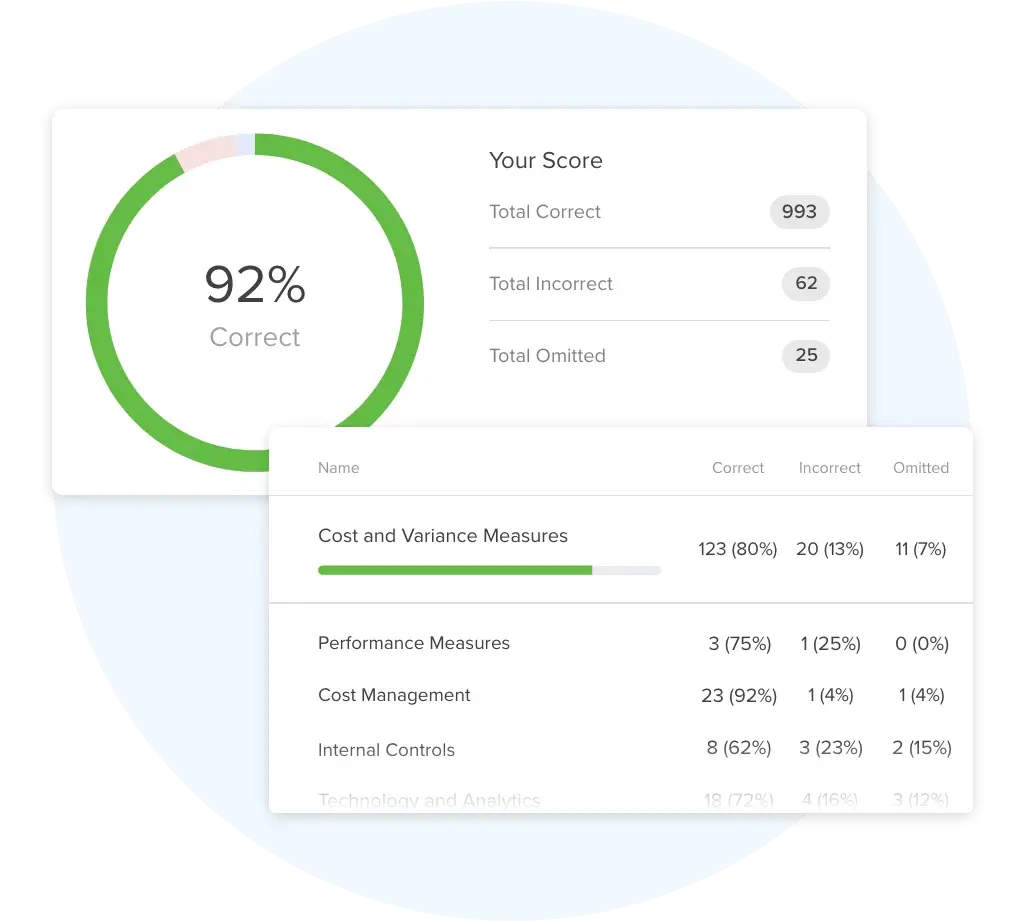
SmartPath Predictive Technology® analyzes your performance across every CMA practice question to help you understand where you stand and what needs more attention. With targeted insights across both exam parts, you can study more efficiently and avoid wasting time on topics you already know.

  • Monitors progress across all question types
  • Highlights areas needing improvement
  • Tracks your progress to targeted goals
Exam-Day Experience

Take Full-Length Practice Exams

  • Practice under the same time pressure and structure as exam day
  • Build your mental stamina with full 4-hour sessions
  • Walk in to exam day with proven confidence
Every Plan, Every Tool

Study Tools Built for Faster Learning

Every tool in UWorld’s CMA review is built to make your study time count. From personalized study plans to a mobile app with cross-device syncing, each feature works together to help you identify gaps, stay on track, and pass faster.

CMA Study Planner

A personalized CMA study planner helps you organize your study time around your availability and target exam date. With a structured plan, you can focus on high priority topics, practice consistently, and track progress with confidence.

  • Enter your start date, target exam date, and available study hours
  • Our algorithm will generate a plan that fits into your life
  • Laid out in an intuitive daily calendar format
  • Track your progress and adjust your plan as exam day approaches
Dynamic Study Planner in calendar view

Reinforce Concepts Faster with CMA Flashcards

UWorld CMA Flashcards are designed to help you retain important information through short and effective study sessions. Review essential formulas, terminology, and key concepts anytime you need a quick refresher before practice sessions or exam day.

  • Review important concepts in minutes
  • Improve recall across both exam parts
  • Target weaker topics with focused review
  • Study whenever and wherever you want
Premade flashcard on solvency

Study Smarter with My Notebook

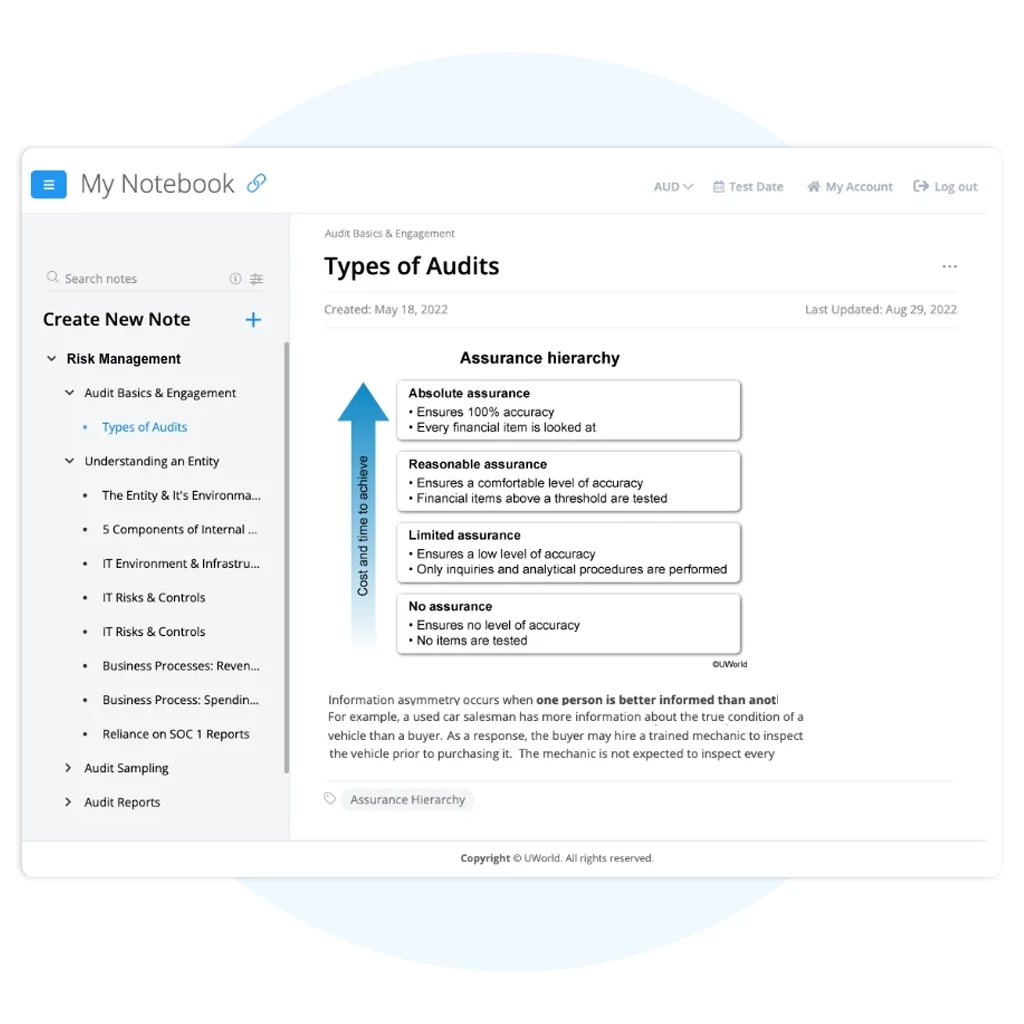
Keep your most important CMA study materials organized and easy to access with My Notebook. Built into the UWorld review course, it allows you to collect highlights, save passages, and create personalized notes without interrupting your study flow.

  • Transfer key passages with 1 click
  • Write custom annotations as you study
  • Organize notes by topic and subject
  • Access your notebook anywhere you study
UWorld CMA Review’s My Notebook feature depicting “Types of Audits” CMA content

Keep Studying Wherever You Are

The UWorld CMA mobile app helps you stay consistent with your exam prep by giving you access to all your study tools in one place. Whether you are reviewing flashcards during a break or completing practice questions while traveling, your progress is always saved and synced.

  • Full CMA review access on mobile
  • Practice MCQs and essays anytime
  • Smart flashcards for better retention on the go
  • Cross-device syncing for uninterrupted prep
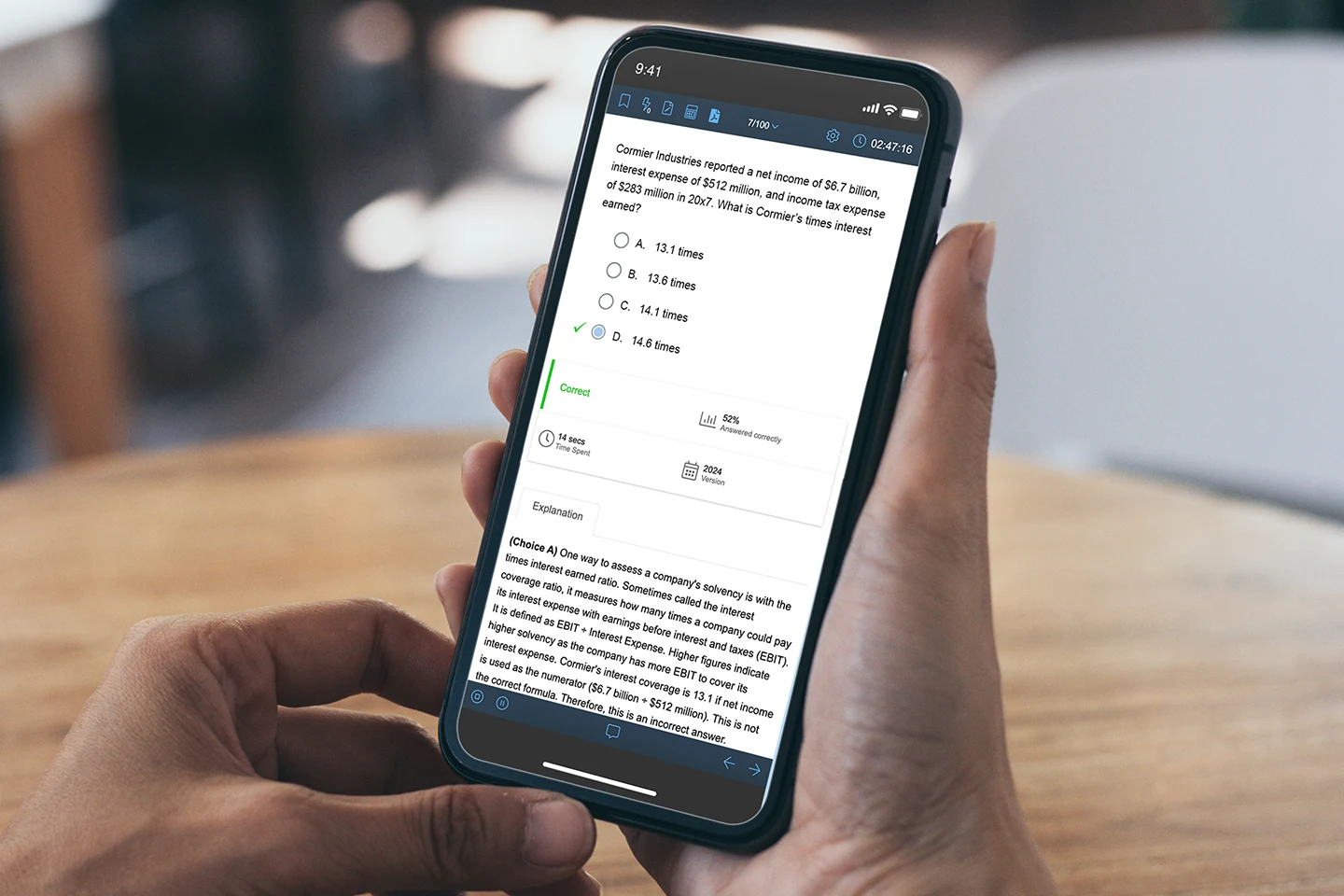
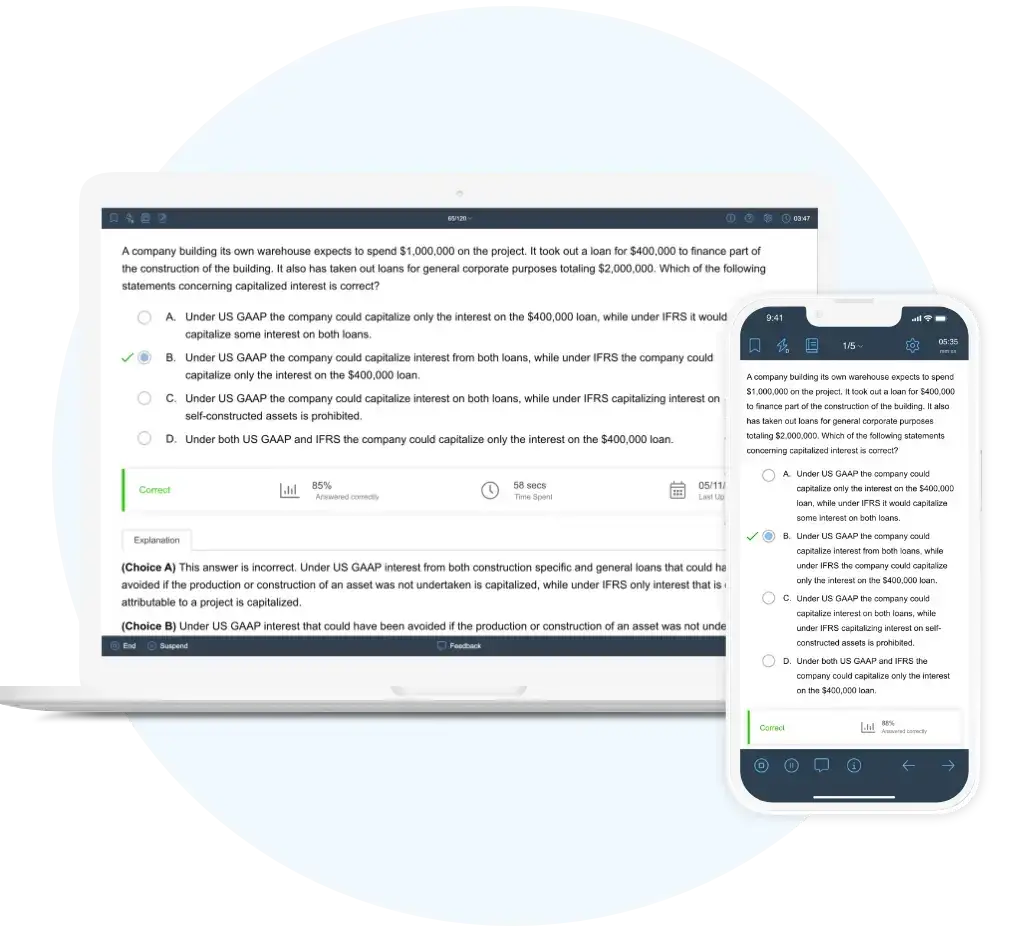
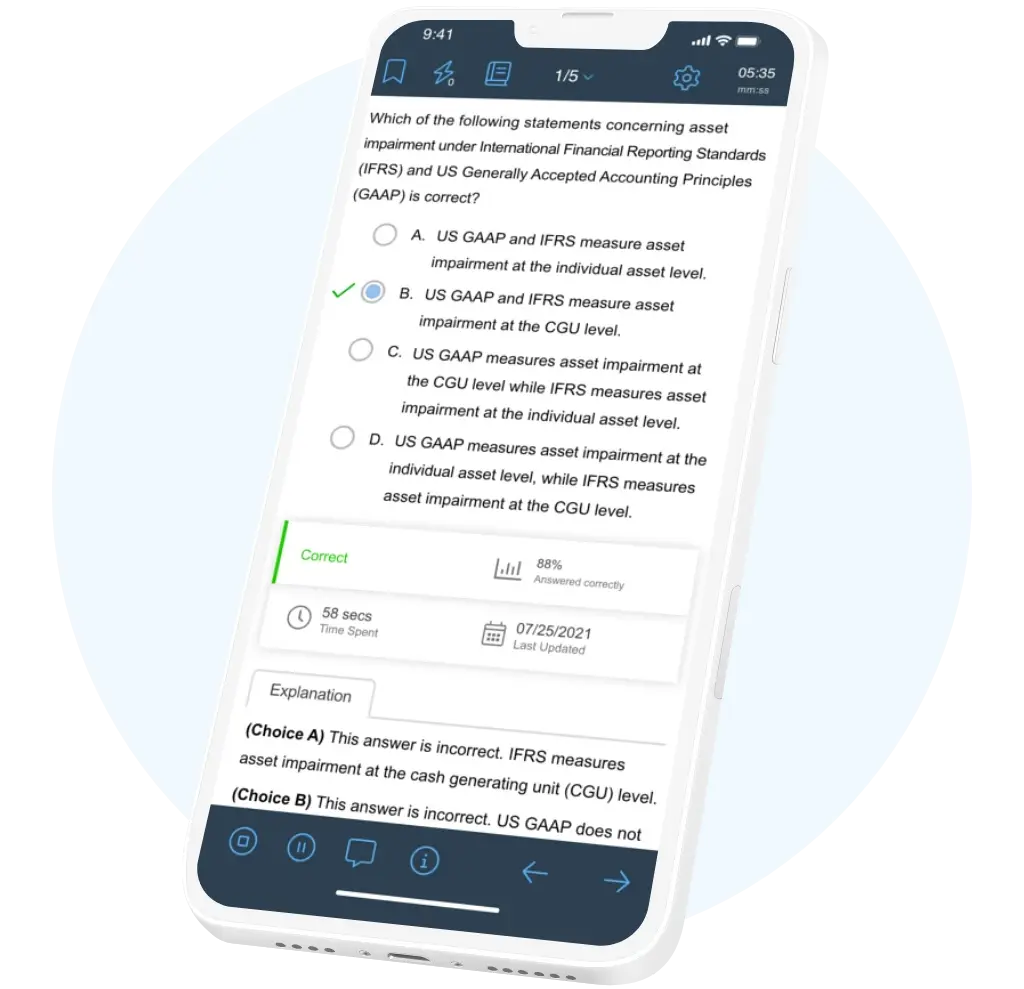
CMA practice question on the UWorld Accounting mobile app
Student Success

What CMA Candidates Say About UWorld

Flexible Plans

Choose Your CMA QBank by Part

All UWorld CMA Review courses include the full QBank, or you may purchase a stand-alone QBank by exam part below.

See the Difference

What Sets UWorld Apart from Other Providers

Not all CMA question banks are built the same. Here is exactly what sets UWorld apart.
Feature UWorld Other Providers
Question Authorship
CMA-Credentialed Authors

Written by experts for real-exam precision

Generalist Authors

Not written by CMAs, leading to imprecise framing

Answer Explanations
Full Concept Explanations

Step-by-step logic to build deep understanding

Not Detailed

Shallow reasoning that leaves gaps in understanding

Visual Illustrations
Visual Question Explanations

Purpose-built charts, diagrams, and exhibits

Majority Text-Only

Few or no visuals, making abstract topics harder to grasp

Question Difficulty
Exam-Appropriate

Calibrated to match actual CMA exam difficulty

Varies

Not calibrated to actual CMA exam difficulty

Curriculum Alignment
Aligned to ICMA LOS

Every question mapped to the current exam

Outdated or Unverified

May include deprecated or irrelevant material

Performance Analytics
SmartPath Analytics

Tracks performance to improve weak areas

Basic Only

No data-driven insight to guide your study path

Question Authorship
UWorld

CMA-Credentialed Authors

Written by experts for real-exam precision

Other Providers

Generalist Authors

Not written by CMAs, leading to imprecise framing

Answer Explanations
UWorld

Full Concept Explanations

Step-by-step logic to build deep understanding

Other Providers

Not Detailed

Shallow reasoning that leaves gaps in understanding

Visual Illustrations
UWorld

Visual Question Explanations

Purpose-built charts, diagrams, and exhibits

Other Providers

Majority Text-Only

Few or no visuals, making abstract topics harder to grasp

Question Difficulty
UWorld

Exam-Appropriate

Calibrated to match actual CMA exam difficulty

Other Providers

Varies

Not calibrated to actual CMA exam difficulty

Curriculum Alignment
UWorld

Aligned to ICMA LOS

Every question mapped to the current exam

Other Providers

Outdated or Unverified

May include deprecated or irrelevant material

Performance Analytics
UWorld

SmartPath Analytics

Tracks performance to improve weak areas

Other Providers

Basic Only

No data-driven insight to guide your study path

Common Questions

CMA Practice Questions (FAQs)

There are many CMA question banks available, and most look similar on the surface. The difference becomes clear the moment you start practicing with UWorld’s CMA practice questions.

Explanations that actually teach. Most CMA practice questions tell you what the correct answer is. UWorld’s CMA practice questions tell you why every answer choice is correct or incorrect, including the ones you did not pick. You stop pattern-matching and start understanding the material, which is exactly what the CMA exam tests. Many questions also include original flowcharts and diagrams so complex concepts stick faster.

Written by CMA-credentialed experts. Every CMA practice question is written by CMA-certified professionals and accounting educators who understand how the ICMA constructs exam content. The difficulty, distractors, and language are deliberately calibrated to mirror the real exam so nothing surprises you on test day.

Always current, always aligned to IMA Learning Outcome Statements. Every CMA practice question maps to the current IMA standards and is updated as soon as changes are confirmed. You are never studying content that is no longer tested.

UWorld’s CMA Review QBank offers multiple-choice questions and case-based questions across both parts of the CMA exam. Questions are distributed across Part 1: Financial Planning, Performance, and Analytics and Part 2: Strategic Financial Management to ensure thorough, balanced preparation. If you want to see what our CMA exam sample questions look like before committing, you can get free access to both parts for 7 days with our free trial.

Yes. The CMA QBank includes full-length practice exams via “Exam Sim” mode, which replicates the CMA exam’s timed, multi-question structure for each part. Each CMA practice exam mirrors the real Prometric environment so exam day feels familiar. You can also generate shorter, customizable quizzes down to the sub-topic level to drill in on specific weak points or build a focused CMA practice test around a single topic you want to master. Each question includes detailed answer explanations, often with visuals like flowcharts or diagrams, so you understand not just what the correct answer is but why.

CMA mock exams are not included in the standalone QBank. They are reserved for CMA Elite-Unlimited packages. The mock exams provide a full CMA exam-like experience: identical interface, format, difficulty, timing, and topic weighting. Critically, CMA mock exams use brand-new questions that have not appeared anywhere else in the QBank, so you can test your true readiness under fresh, unseen conditions rather than questions you may have encountered during study.

Yes. UWorld’s CMA practice questions are fully accessible on smartphones and tablets through the UWorld CMA mobile app, including every CMA exam practice test in Exam Sim mode. The mobile experience is not a stripped-down version. You get the same questions, explanations, performance analytics, and customization tools available on desktop. You can seamlessly switch between devices and pick up exactly where you left off, making it easy to fit study sessions into your day no matter where you are. 

Yes. Some of our CMA exam sample questions are modeled directly on content released by the IMA, while others are written by our in-house team of CMA-certified professionals and accounting educators with direct experience in CMA exam preparation. Every question is reviewed to ensure it reflects the style, difficulty, and format of what you will see on the actual exam. Candidates looking for a true CMA practice test experience will find that UWorld’s questions closely mirror the style, structure, and difficulty of official IMA exam content.

The CMA QBank includes multiple-choice questions (MCQs) and case-based questions (CBQs), both modeled after the real CMA exam format. MCQs test your knowledge and application of concepts across financial planning, performance management, cost management, and strategic financial management, while essay questions require you to apply that knowledge to realistic scenarios, just as you would on the actual exam. Together, they prepare you for every type of CMA test practice questions you will encounter across both exam parts.

Yes. UWorld’s CMA QBank gives you full control over how you practice. You can build custom quizzes filtered by topic, subtopic, difficulty level, question type, or unused and previously incorrect questions. This means you can focus an entire session on a single concept you are struggling with, or mix question types to simulate a more varied study experience. The flexibility lets you study in a way that matches your schedule and your specific gaps, without wasting time on material you have already mastered. Think of each session as a targeted CMA practice test built around your weakest areas.

Yes. The CMA QBank is integrated with SmartPath Predictive Technology, which tracks your performance in real time across every topic in both exam parts. SmartPath analyzes your results to identify weak areas, adjusts your recommended study path accordingly, and helps you stay on pace with proven targets. Rather than guessing whether you are ready, you always have a data-driven picture of your exact readiness level so your CMA review questions are always focused on what actually moves your score.

Yes. All UWorld CMA Review packages include full access to the QBank as a core part of the course. It is also available during your 7-day free trial, so you can explore the full question library, explanations, and analytics before making any commitment. There is no credit card required to start, and you get access to both exam parts from day one.

Scroll to Top